


Understanding Diversity, Equity, and Inclusion: A Triad of Organizational Values
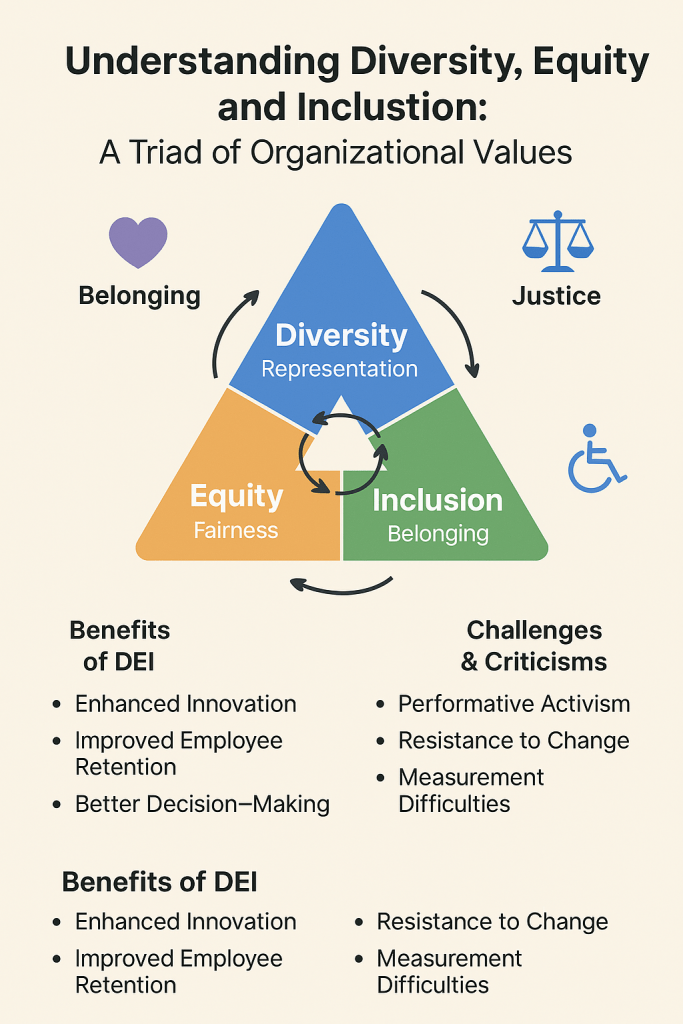
Diversity, Equity, and Inclusion (DEI) have become central pillars in modern organisational frameworks, shaping workplace cultures, policies, and societal norms. Though distinct, these three notions are deeply interconnected, representing values organisations strive to institutionalise to foster fairness, representation, and belonging. While the terminology of DEI is relatively recent, the concepts have long existed, evolving alongside social justice movements. Variations of these frameworks sometimes incorporate extra terms like belonging, justice, and accessibility, further expanding their scope. This essay examines the meanings of diversity, equity, and inclusion. It discusses their interdependence. The essay also covers their broader implications in organisational and societal contexts.
Defining Diversity, Equity, and Inclusion
1. Diversity: Representation and Varied Perspectives
Diversity refers to the presence of differences within a given setting. These differences may include race, ethnicity, gender, age, religion, disability, sexual orientation, socioeconomic background, etc. In an organisational context, diversity ensures that a wide range of identities, experiences, and perspectives are represented.
However, diversity alone is not enough. Simply having a varied workforce does not guarantee that all voices are heard or valued. This is where equity and inclusion come into play, ensuring that diversity is not merely superficial but meaningful and impactful.
2. Equity: Fairness in Opportunity and Access
Equity goes beyond equality, assuming everyone benefits from the same resources. Instead, equity recognises that individuals start from different positions and may require different levels of support to achieve the same outcomes.
An equitable workplace might provide additional mentorship programs for underrepresented employees or adjust hiring practices to reduce bias. Equity seeks to dismantle systemic barriers preventing marginalised groups from thriving, ensuring that policies and practices are impartial.
3. Inclusion: Creating a Culture of Belonging
Inclusion is the active effort to make all individuals feel welcomed, respected, and valued within an organisation. Diverse representation is not enough if certain groups feel excluded or tokenised. Inclusion involves fostering an environment where everyone can contribute fully without fear of discrimination or marginalisation.
Inclusive practices may include:
– Encouraging open dialogue and feedback
– Implementing bias training
– Creating employee resource groups (ERGs)
– Ensuring leadership reflects the diversity of the workforce
The Interconnected Nature of DEI
Diversity, equity, and inclusion are distinct concepts but interdependent. A genuinely inclusive environment cannot exist without equity; diversity efforts are hollow if they do not lead to inclusion. Consider the following relationships:
– Diversity without Inclusion → A diverse workforce where minority groups feel marginalised or silenced.
– Inclusion without Equity → A welcoming environment that fails to address systemic disadvantages.
– Equity without Diversity → Fair policies that do not necessarily result in varied representation.
Thus, organisations must address all three components holistically to create meaningful change.
Expanding the Framework: Belonging, Justice, and Accessibility
Some DEI models extend beyond the core triad, incorporating additional elements such as:
Belonging
Belonging refers to the emotional and psychological experience of feeling accepted and valued within a group. While inclusion focuses on organisational efforts, belonging is about individual perception. A workplace may have inclusive policies, but the DEI efforts are incomplete if employees still feel like outsiders.
Justice
Justice emphasises addressing historical and systemic inequities. It goes beyond individual fairness to examine broader societal structures that perpetuate discrimination. For example, justice-oriented DEI initiatives advocate for reparative policies or challenge institutional racism in hiring practices.
Accessibility
Accessibility ensures that environments, products, and services are usable by people with disabilities. This includes physical accommodations (e.g., wheelchair ramps) and digital accessibility (e.g., screen-reader-friendly websites). True inclusion can’t exist without accessibility.
The Business Case for DEI
Beyond moral and ethical imperatives, DEI has tangible benefits for organisations:
1. Enhanced Innovation – Diverse teams bring varied perspectives, leading to more creative solutions.
2. Improved Employee Retention – Inclusive workplaces foster loyalty and reduce turnover.
3. Better Decision-Making – Equity ensures all voices are heard, preventing groupthink.
4. Stronger Reputation – Companies committed to DEI attract top talent and consumer support.
Challenges and Criticisms
Despite its importance, DEI faces challenges:
– Performative Activism – Some organisations adopt DEI as a checkbox exercise rather than a genuine commitment.
– Resistance to Change – Employees or leaders may push back against DEI initiatives, viewing them as unnecessary or unfair.
– Measurement Difficulties – Quantifying the success of DEI efforts can be complex, requiring long-term tracking.
Conclusion
Diversity, equity, and inclusion are essential values and buzzwords for building fair and thriving organisations. The terminology evolves by incorporating concepts like belonging, justice, and accessibility. Still, the core goal remains the same: creating environments where all individuals have the opportunity to succeed. True DEI requires ongoing effort, systemic change, and a challenge to ingrained biases. Organisations can move toward a more just and inclusive future by institutionalising these principles.
Catch up with me at nicospas@gmail.com.
 Nicos Paschali, International Author, Designer & Facilitator of Learning Workshops. Mental Discipline Coach.
Reply