


Balancing strategy and execution.
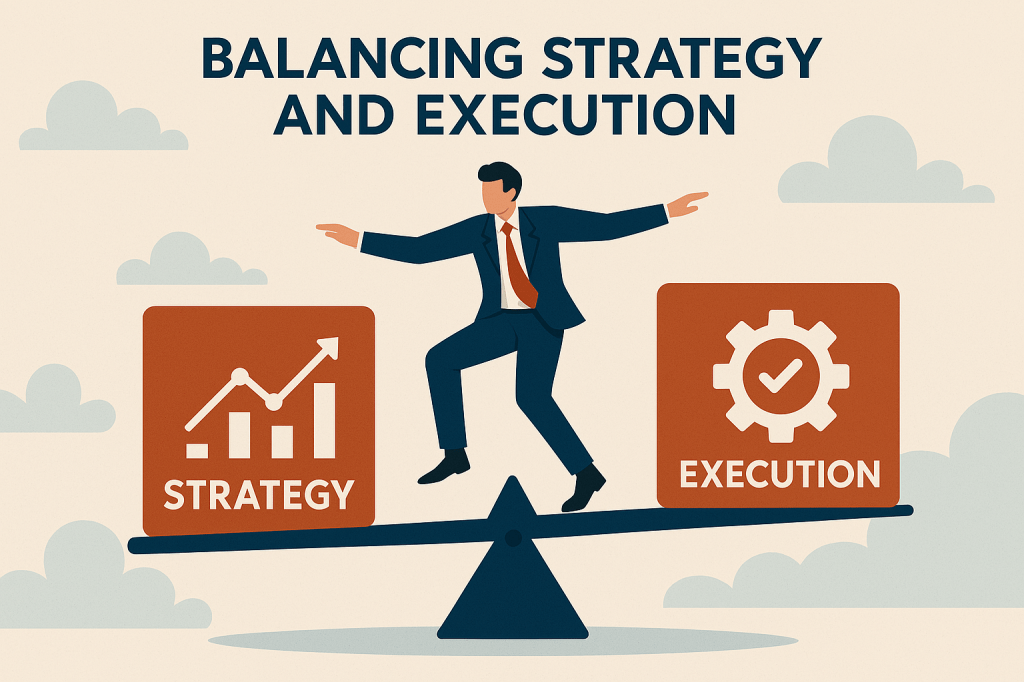
Balancing strategy and execution
As a manager who works closely with your team, it’s easy to get caught up in day-to-day tasks. When new projects arise, and your team does not know how to handle them, you might take them on yourself. It might seem simpler than teaching someone else. Alternatively, if you want certain tasks done your way, you might just do them yourself. In many situations, you can fall into the trap of becoming an executive executor.
If this resonates with you, you’re not alone. McKinsey found that managers spend nearly half their time on individual contributor work, limiting their brainstorming and planning capacity. As managers navigate between strategy and execution, they often fail to utilise their employees effectively. Your team likely needs your assistance with individual contributor tasks. However, it’s crucial to be selective.
So, how can you balance your time between focusing on long-term vision and day-to-day tasks?
Differentiate goals and objectives.
Some managers use the terms “goals” and “objectives” interchangeably, but there is an important distinction. Goals represent the broad, long-term direction. This is the direction in which your company aims to head. Objectives are the specific, measurable targets. They support the achievement of those goals. Your team’s goals should align with your company’s goals, featuring 2-3 concrete objectives for each goal. For example, if your goal is to expand your company’s influence in a new market, one objective could be to increase LinkedIn followers. Aim for a 20% increase within six months. Having clear, time-bound objectives helps you focus on what matters. This ensures that you invest your time only in projects that make a significant impact.
Choose your tactics wisely.
Delegate tasks based on your team members’ strengths and the areas they wish to develop. As a manager, limit yourself to taking on one tactic personally. This allows you to be accountable while modeling effective management and communication on projects. When assigning tactics, ask yourself: “Am I the right person to execute this, or can I delegate it?” and “Have I taken on too much execution, leaving insufficient time for strategy?” Thoughtfully balancing your time will help you avoid feeling overwhelmed and maintain a strategic perspective.
Create strategic focus time.
As a leader, you must establish boundaries to prioritize big-picture thinking. Constantly responding to messages, phone calls, or accepting every meeting that arises on your calendar can deplete your time and energy. This leaves you little opportunity to concentrate. To create focused time, block off specific periods of the day for deep work and silence your apps during these intervals. Inform your team that meetings should have clear agendas to maintain everyone’s focus. By eliminating distractions, you can create time to evaluate how your projects are progressing while also remaining grounded in the details.
Upskill your strategic skills.
Managers must continuously learn and evolve to advance company strategy. Begin by identifying gaps in your knowledge related to the company’s strategic vision and dedicate time each week to upskill in those areas. In an era where AI developments are constant, it’s crucial to stay ahead of the curve. By prioritizing your upskilling, you position yourself as a strategic partner to your company’s leadership team, supporting ongoing business transformation.
 Nicos Paschali, International Author, Designer & Facilitator of Learning Workshops. Mental Discipline Coach.
Reply