


The Transformative Power of Student Questioning: Fostering Deeper Learning Through Inquiry
Introduction
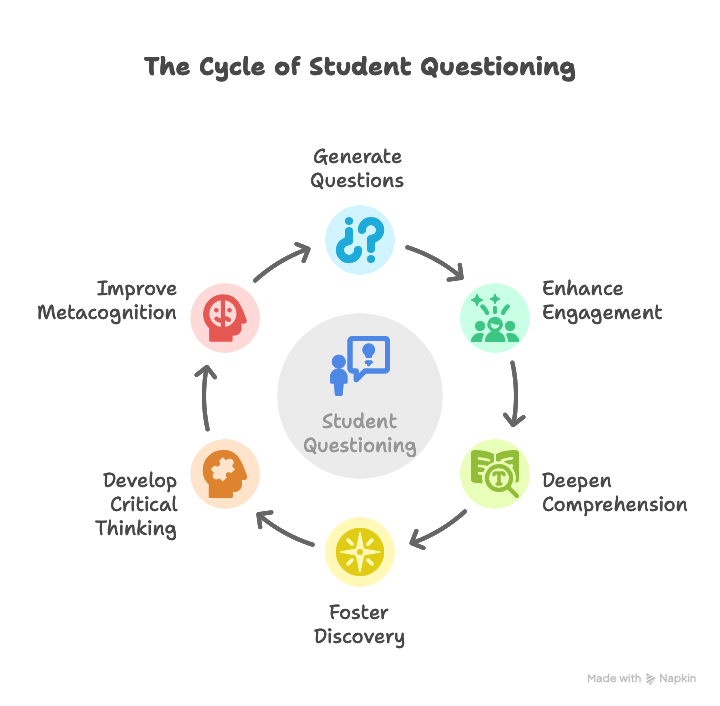
Information is readily accessible at our fingertips in this era. The ability to generate meaningful questions has become more crucial than ever. This skill is essential for effective learning. Traditional education often emphasises providing answers. However, a growing body of research demonstrates that teaching students to ask better questions fundamentally transforms their educational experience. This essay examines the profound impact of student questioning on learning outcomes. It explores how the simple act of formulating questions can enhance engagement. This process deepens comprehension and fosters discovery. It also develops critical thinking skills that extend far beyond the classroom.
The capacity to ask thoughtful questions represents a cornerstone of intellectual development. However, it remains an underutilised pedagogical tool in many educational settings. Research indicates that students generating questions in the classroom facilitates engagement, comprehension, and discovery. Ultimately, it contributes to the development of more motivated lifelong learners. This comprehensive analysis draws from extensive research. It shows how systematic question formulation can revolutionise student learning experiences. This occurs across diverse educational contexts.
The Multifaceted Impact of Student Questioning
Enhanced Engagement and Motivation
One immediate and observable advantage of teaching students to generate their questions is a marked increase in classroom engagement. This engagement becomes obvious quickly. Working intentionally to generate questions engages students deeply in learning. It involves them on a behavioural level by asking questions. It also engages them cognitively with deeper thinking and effectively with positive feelings towards learning. This multi-dimensional engagement transforms passive recipients of information into active participants in their learning journey.
The motivational impact of student-generated questioning can’t be overstated. Three-quarters of sixth graders in a study by Chin and Kayalvizhi (2005) preferred to investigate questions they posed themselves. They enjoyed this more compared to simply answering investigative questions given in their textbooks. These students reported feeling “happy,” “excited,” or “proud” about generating their questions. They described the experience of investigating the questions as “thrilling,” “fun,” and “interesting.” This emotional connection to learning creates a robust foundation for sustained academic engagement.
Recent research from secondary biology classrooms found that students commented that teachers’ questions helped them think. They also mentioned it helped them concentrate. One student remarked, “Questioning can trigger our thinking, engage the classroom and attract our attention to the teaching content. That is, they can improve our learning efficiency and enhance learning outcomes.” This suggests that both teacher-initiated and student-generated questions play complementary roles in creating dynamic learning environments.
Deeper Comprehension and Academic Performance
Beyond engagement, student questioning directly contributes to enhanced comprehension and measurable academic improvements. Asking one’s questions stimulates both cognitive and metacognitive activity, contributing to a deeper understanding. In many studies, such improvements in comprehension are demonstrated through higher academic performance. This is measured by memory retention. Test scores and effective problem-solving are also indicators.
The cognitive benefits extend to students with diverse learning needs. Question generation significantly improves reading comprehension among fourth- through sixth-grade students with learning disabilities. It enhances memory recall. It also facilitates the identification and integration of main ideas. This is based on a meta-analysis of 13 studies on question generation. This finding suggests that questioning strategies are particularly valuable for supporting inclusive education practices.
Recent research confirms these effects persist regardless of question quality. Generating questions improved students’ test performance, regardless of the quality of the questions they raised. Instructing learners to generate questions based on the learning material led to medium to large effects. These effects were observed in comprehension, recall, and problem solving. This shows that formulating questions drives improvements in learning. The sophistication of the questions produced is less important.
Discovery and Creative Thinking
Student questioning catalyses discovery and creative exploration. Asking questions can provoke new ideas and lead to open exploration. By asking questions, students exercise high-level thinking, like challenging assumptions, hypothesising, and investigating possibilities. This process transforms learning from a passive absorption of predetermined content to an active exploration of unknown territories.
Researchers emphasise the creative potential of questioning. They note that “Questions are designed to probe, to find something that is not already there. Questions discover relationships and possibilities that are not given.” This perspective reframes education as a process of knowledge creation. It moves beyond mere knowledge transmission. Students become active contributors to understanding rather than passive recipients.
Question asking is a way to expand one’s knowledge. It promotes cognitive skills that lead to discovery. These include articulating and finding problems. They also involve making predictions, developing hypotheses, noticing and challenging assumptions, and generating new ideas. These skills are fundamental components of scientific thinking and innovation. They suggest that questioning pedagogy prepares students for roles as future researchers, entrepreneurs, and critical thinkers.
Metacognitive Development
The long-term benefits of student questioning are significant. One key advantage is its impact on metacognitive development. This includes students’ awareness and understanding of their thought processes. Self-questioning is one of the most effective metacognitive strategies. Engaging in pre-lesson self-questioning has been shown to improve students’ learning rate by nearly 50%. This dramatic improvement demonstrates the power of reflective questioning practices.
Contemporary research supports this connection between questioning and metacognition. Studies have shown that metacognition is positively correlated with critical thinking. Instruction in critical thinking significantly impacts students’ metacognitive processes. One consequence of this is that vital thinking improves with the use of metacognition. This creates a positive feedback loop where questioning enhances metacognitive awareness, which in turn improves vital thinking abilities.
Teaching students to ask the right questions is a crucial skill. It is not just an essential life-skill but also an important metacognitive skill. After all, students can’t develop independent research skills without thinking skills. They need these skills to interrogate claims they find on the internet and from various information sources in their lives. This metacognitive dimension of questioning becomes increasingly crucial in our information-rich digital age.
Question Formulation: A Structured Approach
Question Formulation is a systematic approach to developing students’ questioning skills. The QF involves learners of all ages, levels, and disciplines in a step-by-step process. It teaches them how to craft and enhance questions. They learn to strategise their use and think about their learning. It provides students with skills they can apply across all areas of learning throughout their lives.
Research on the QF demonstrates its effectiveness across diverse educational contexts and age groups. Using the Question Formulation (QF) with early learners helps them generate more questions. It also leads to better-quality questions. Additionally, it supports the acquisition of key pre-literacy skills. By the end of the summer program, these young learners exhibited a significant increase in the number of questions posed. There was a qualitative improvement in the type of questions posed, with more wonderment questions. Their average scores improved for all measures of oral language and emergent literacy areas.
The technique’s effectiveness extends to higher education contexts as well. The QF was used repeatedly with undergraduate students in an upper-division biology class. This supported them to ask more questions related to course themes by the end of the term. Analysis of student reflections revealed that students enjoyed the process. They were excited by their own questions. The process helped them to explore biology topics creatively and collaboratively.
Implications for Science Education
Science education particularly benefits from questioning pedagogies due to the discipline’s inherently inquiry-based nature. Teaching students questioning skills can significantly deepen their understanding of science subjects, increase engagement, and stimulate active learning. A summary of nine research studies on questioning in science is available. These studies highlight the crucial role teachers play in supporting students. They help develop students’ interviewing skills. This support, in turn, enhances science learning.
Recent research in primary science education demonstrates how guided inquiry pedagogy can aid critical thinking through questioning. The study indicates that discipline-specific multimodal signs, visuals, diagrams, models, and material manipulations can be adopted and refined. These tools promote and enhance the critical thinking and meaning-making that are central to science inquiry processes. Effective questioning in science education requires attention to pedagogical strategies. It also needs the use of appropriate tools and representations.
Social Learning and Collaborative Benefits
Student questioning enhances not only individual learning but also collaborative knowledge construction. Group question-asking encourages students to co-construct knowledge, leading to productive discussions. Student questions in one group also stimulated members of another group. All students used key thinking strategies like hypothesising, predicting, and explaining in their search for an answer.
Asking questions in groups has a significant positive effect on learning communities. When students expressed their thoughts as questions, they listened to others more attentively. They also took more ownership in their learning. These collaborative benefits suggest that questioning strategies can enhance individual learning outcomes. They also foster positive classroom dynamics. Additionally, they improve peer relationships.
Challenges and Implementation Considerations
Despite the overwhelming evidence supporting student questioning, implementation challenges persist. Teachers predominantly ask lower-level cognitive questions that do not effectively stimulate critical thinking. Researchers observed 91 faculty members during classroom-based instruction. They documented 3,407 questions. The researchers categorised the type and level of each question posed. The majority of the questions asked were of a lower level (68.9%).
Contemporary research emphasises that attention has been primarily cast on the format of questioning. This includes open-ended questions that prompt student interactions or class discourses. Yet, not much focus is given to the science content embedded in questions. Little is known about how they guide students toward learning objectives. This suggests that effective implementation requires both attention to question quality and alignment with learning objectives.
Future Directions and Technology Integration
As educational contexts continue to evolve, the role of questioning becomes even more critical. This is especially true with the integration of digital technologies. Recent studies examining e-learning contexts confirm that metacognition is positively linked to critical thinking. This establishes the need to provide management professionals with tools to develop metacognition. Enhancing metacognition promotes critical thinking prowess in e-learning.
Fostering creative thinking and promoting metacognitive processes are two key objectives of 21st-century education. Emerging research on meta-creative pedagogy suggests this. Interventions based on metacognitive monitoring lead to enhanced creative thinking. This suggests that questioning strategies will continue to evolve to meet the demands of modern education.
Conclusion
The research overwhelmingly demonstrates a significant finding. Teaching students to ask better questions is one of the most powerful pedagogical interventions available to educators. Student questioning increases engagement and motivation. It enhances comprehension, discovery, and metacognitive development. This transformation converts learning from a passive process to an active one. The benefits extend beyond academic achievement to include improved collaborative skills, creative thinking, and the development of lifelong learning capabilities.
Structured approaches to question formulation give educators with concrete tools for implementing questioning strategies across diverse educational contexts. Nevertheless, successful implementation requires attention to question quality. It also needs alignment with learning objectives. Additionally, the creation of supportive learning environments is necessary. These environments should encourage intellectual risk-taking.
As we move ahead in an increasingly complex and rapidly changing world, the ability to generate meaningful questions becomes critical. It is not just an educational tool but a fundamental life skill. Students who learn to question effectively are better prepared to navigate uncertainty. They can evaluate information critically. They also contribute to the ongoing construction of knowledge in their chosen fields. The evidence is clear. When we teach students to ask better questions, we equip them with cognitive tools. These tools are necessary for success in education, careers, and citizenship in the 21st century.
The transformation from passive recipients to active questioners signifies the most significant shift students can make in their educational journey. As educators, we face the challenge of creating environments where questioning is actively encouraged. It must be systematically developed as a core competency. The research provides a roadmap for this transformation. It offers evidence-based strategies. These strategies can revolutionise how we approach teaching and learning across all disciplines and educational levels.
 Nicos Paschali, International Author, Designer & Facilitator of Learning Workshops. Mental Discipline Coach.
Reply