


Accelerating Learning: The Convergence of Neuroscience, Cognitive Psychology, Growth Mindset and Artificial Intelligence.
Accelerating Learning: The Convergence of Neuroscience, Cognitive Psychology, Growth Mindset, and Artificial Intelligence
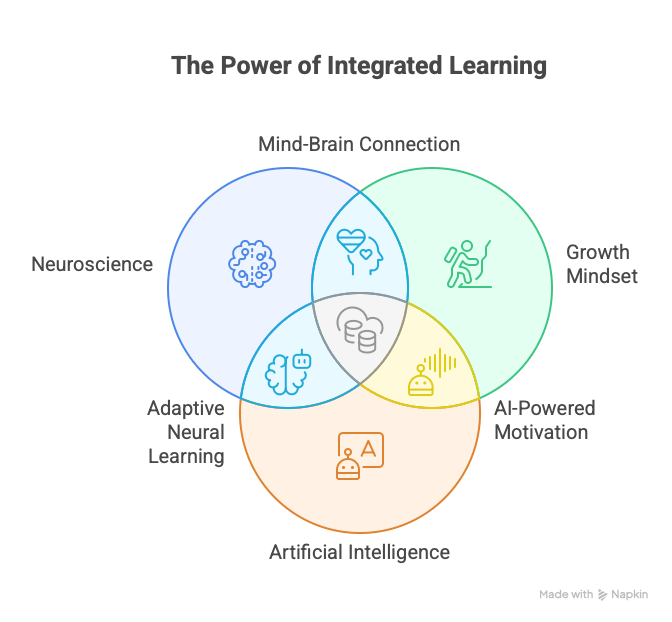
The quest to understand and optimise human learning has never been more urgent or promising. We are facing an era of rapid technological change and information explosion. The ability to learn quickly and effectively has become a crucial skill for personal and professional success. Three powerful forces are coming together to change our approach to learning. First, there are insights from neuroscience on how the brain acquires knowledge. Secondly, there is the psychological framework of a growth mindset. Finally, the emerging capabilities of artificial intelligence are also contributing. Together, these elements create unprecedented opportunities to accelerate learning in ways that were unimaginable just decades ago.
The Neuroscientific Foundation of Learning
Neuroscience has fundamentally changed our understanding of how learning happens on a biological level. The discovery of neuroplasticity has revealed the brain’s ability to reorganise itself throughout life. This discovery has shattered the outdated idea that adult brains are fixed and unchangeable. Research shows that each time we learn something new, we reshape our neural networks. We form stronger connections between neurons. New brain cells are even generated in specific areas.
This biological fact has significant implications for learning strategies. Neuroscience shows that effective learning requires active participation rather than passive absorption. We find difficult material challenging. This challenge stimulates the release of brain-derived neurotrophic factor (BDNF). BDNF is a protein that encourages the growth of new neural connections. This demonstrates why difficulty and confusion, rather than being barriers to learning, are vital parts of the learning process.
The spacing effect is supported by decades of neuroscientific research. It shows that spaced practice over time enhances memory consolidation more effectively than massed practice. When we revisit information at increasing intervals, we strengthen the neural pathways linked to that knowledge. This makes it more accessible for future use. Likewise, studies on sleep and learning show that consolidation continues after studying ends. The brain processes and integrates new information during rest periods.
Understanding attention and cognitive load also offers essential insights for speeding up learning. The brain’s working memory has limited capacity, and when it becomes overwhelmed, learning efficiency drops sharply. Neuroscience-informed techniques simplify complex information into manageable parts. They use multimedia presentations that engage multiple neural pathways. These techniques also remove unnecessary cognitive load that does not support learning objectives.
Growth Mindset as a Learning Catalyst
Carol Dweck’s research on the growth mindset provides the psychological framework that transforms how learners approach challenges and setbacks. Individuals with a growth mindset believe that abilities and intelligence can be developed through effort, strategy, and persistence. This fundamental belief about the nature of ability creates a cascade of positive learning behaviours that accelerate skill acquisition.
Growth mindset directly influences how learners interpret difficulty and failure. Rather than viewing struggles as evidence of inadequate ability, growth-minded learners see them as natural parts of the learning process. This reframing is crucial because it maintains motivation during the inevitable challenging phases of skill development. When learners believe that effort leads to improvement, they are more to persist through difficulties. They also seek out challenging material that promotes growth.
The mindset also affects strategy choice and help-seeking behaviour. Growth-minded learners are more inclined to experiment with different approaches when first techniques don’t work. They actively seek feedback. They also learn from others’ successes. They view mistakes not as failures but as information that guides future learning efforts.
Most importantly, a growth mindset fosters a learning identity that extends beyond specific subjects or skills. When learners see themselves as capable of growth and improvement, they approach new domains with confidence and curiosity. They do this rather than feeling anxiety about revealing their limitations. This psychological safety enables the risk-taking and experimentation necessary for accelerated learning.
The combination of a growth mindset with neuroscientific insights creates a powerful synergy. Understanding that struggle fosters brain growth provides tangible evidence for growth mindset beliefs. Growth mindset offers the psychological resilience needed to embrace challenging experiences. These experiences promote neuroplasticity.
Artificial Intelligence as a Learning Accelerator
Artificial intelligence is the third pillar of this learning revolution. It offers unprecedented opportunities to personalise, optimise, and scale engaging learning experiences. AI systems can analyse large amounts of learning data to detect patterns. They improve instructional techniques in real-time. These systems create adaptive learning environments that respond to individual learner needs.
Personalisation is one of AI’s most significant contributions to faster learning. Traditional education often uses a one-size-fits-all approach that ignores differences in prior knowledge, learning preferences, and cognitive abilities. AI systems can continuously evaluate learner understanding and adjust content difficulty, presentation style, and pace suitably. This dynamic adaptation ensures learners stay in their optimal challenge zone. It is difficult enough to promote growth but not so overwhelming as to cause frustration or disengagement.
Intelligent tutoring systems use AI to offer immediate, personalised feedback that guides learners towards correct understanding. Human teachers are unavailable or overwhelmed by large classes. In contrast, AI tutors can respond instantly to questions. They can also find misconceptions early. This quick feedback speeds up learning by preventing the practice of incorrect techniques and offering corrective guidance when needed.
AI also excels at optimising spaced repetition, using algorithms to decide the best times for reviewing earlier learned material. AI systems analyse individual forgetting curves and learning patterns. They can schedule review sessions just as memories start to fade. This maximises retention and reduces time spent.
AI can use natural language processing to engage learners in complex conversations. It answers questions and offers explanations. It can even engage in Socratic questioning that encourages deeper understanding. This conversational ability makes AI tutors more natural and engaging learning partners.
The Synergistic Integration
The true power of these three elements emerges when they work together rather than separately. Neuroscience provides the biological foundation for understanding ideal learning conditions. The growth mindset provides the psychological framework for embracing these conditions. AI provides the technological ability to deliver personalised learning experiences at scale.
Think about how this integration will work practically. An AI learning system can use neuroscientific principles to create learning sequences. These sequences encourage active recall and spaced repetition. This system also monitors cognitive load to prevent overload. This system can also embed growth mindset principles. It accomplishes this by presenting challenges as opportunities for brain development. It offers process-oriented feedback that emphasises effort and strategy rather than innate ability. Additionally, it recognises progress rather than just achievement.
The AI system can help when learners face difficulties. It will apply growth mindset research. This would give encouragement that reimagines struggle as brain-enhancing activity. It suggests strategies based on neuroscientific insights into how different approaches trigger various neural pathways. Additionally, this tool track progress in ways that make neuroplastic changes visible to learners. It would reinforce growth mindset beliefs with tangible evidence of improvement.
The data produced by AI learning systems opens new avenues for neuroscientific research. Large-scale analysis of learning patterns can offer valuable insights. It helps decide the best instructional sequences. It also reveals individual preferences in learning and the success of different teaching approaches. This research can then guide the development of even more effective AI learning systems, creating a continuous cycle of advancement.
Implications and Future Directions
The convergence of neuroscience, growth mindset, and artificial intelligence suggests several important implications for the future of learning. Educational institutions will need to rethink traditional instructional models. These models often rely heavily on passive information transmission. Instead, there should be a focus on active, personalised learning experiences. Professional development programmes will need to incorporate these insights to help workers adapt to rapidly changing skill requirements.
The democratisation of high-quality, personalised learning experiences help solve educational inequities. It provides all learners access to adaptive instruction. Such instruction was once available only to those with access to expert human tutors. Yet, this potential must be balanced against concerns about digital divides. It is also important to consider the importance of human connection in the learning process.
As these technologies mature, we will see the emergence of learning approaches that seem almost magical compared to traditional techniques. Imagine AI systems that can predict optimal learning conditions based on physiological markers. They adjust instruction based on real-time neural feedback. These systems will also create immersive virtual reality experiences. These experiences would engage multiple senses in service of learning objectives.
The integration of neuroscience, growth mindset, and artificial intelligence is more than just technological advancement. It embodies a fundamental shift towards understanding learning as a dynamic process. This process is personalised and optimisable. We are entering a new era by combining biological insights about how the brain learns. Psychological frameworks that promote learning resilience are also important. Technological tools allow personalisation at scale. As a result, accelerated learning is not just possible but increasingly accessible to all learners.
The challenge now lies not in the availability of these tools and insights. It lies in thoughtfully integrating them. They must be integrated in ways that honour both the complexity of human learning and the potential of technological enhancement. As we progress, the most effective learning environments will seamlessly blend neuroscientific understanding and growth-oriented psychology. They will also incorporate intelligent technology. These elements together create experiences that are both highly effective and deeply human.
#AcceleratedLearning #NeuroscienceEducation #GrowthMindset #AILearning #Neuroplasticity #PersonalizedEducation #BrainBasedLearning #EdTechInnovation #LifelongLearning #FutureOfEducation
 Nicos Paschali, International Author, Designer & Facilitator of Learning Workshops. Mental Discipline Coach.
Reply