Unlock Your Potential Through the Power of Thoughtful Inquiry.
The key elements of active listening, reflection, and curiosity with a dynamic and intellectually engaging background.
Developing strong questioning skills is essential for personal and professional growth, leading to better decision-making and problem-solving abilities.
Dive into the transformative power of asking the right questions and watch your success unfold.
• Practice Active Listening: Engage fully in conversations to enhance your questioning abilities
– Focus on absorbing details and nuances during interactions
– Strive to understand different perspectives and viewpoints
– Use active listening as a foundation for formulating insightful questions
• Reflect Regularly: Analyze your questioning techniques to improve their effectiveness
– Review the questions asked during meetings and decision-making processes
– Identify opportunities for more impactful or probing inquiries
– Learn from past experiences to refine your questioning approach
• Embrace Curiosity: Cultivate a mindset of continuous inquiry and exploration
– Challenge yourself to look beyond initial answers and surface-level information
– Question assumptions and seek deeper understanding of complex issues
– Foster a genuine interest in learning and discovering new perspectives
Call to Action: Start honing your questioning skills today by actively listening, reflecting on your inquiries, and embracing curiosity in all aspects of your life and work.
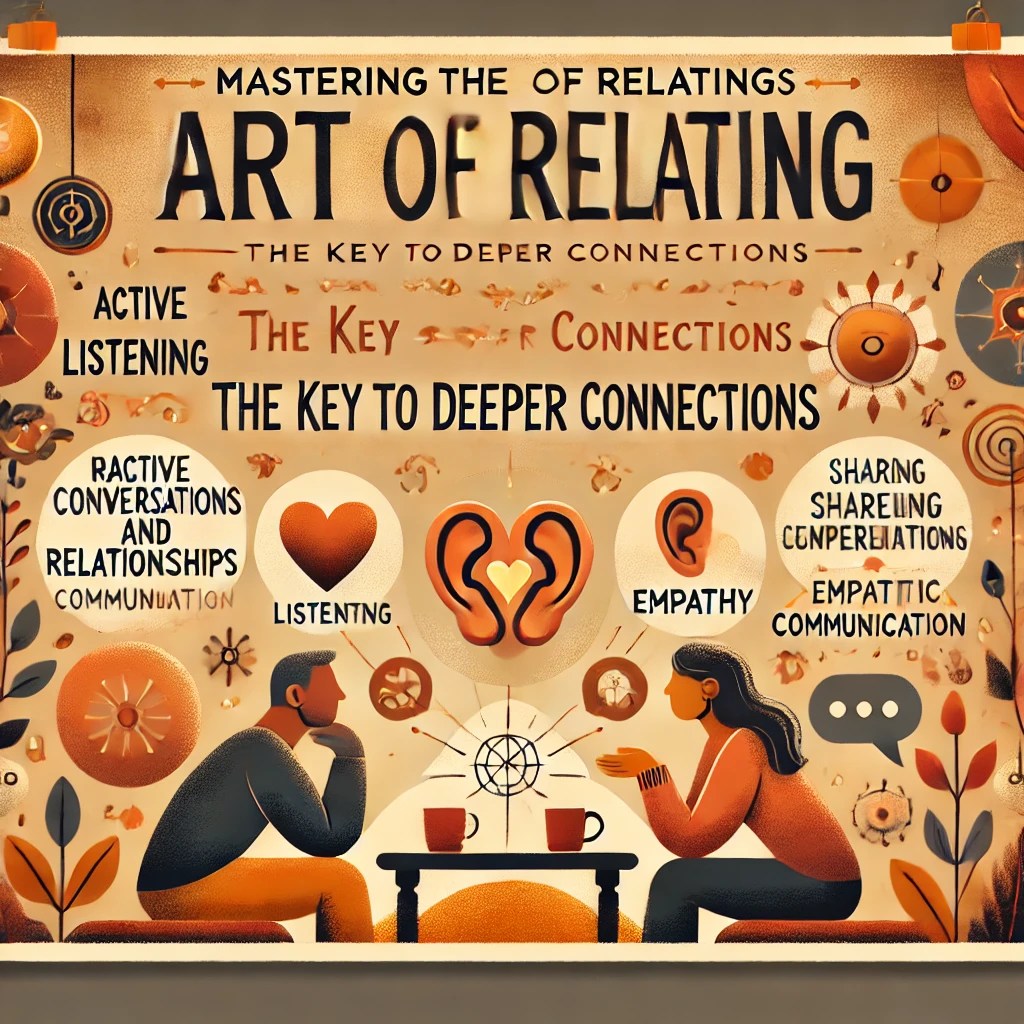
Mastering the Art of Relating: The Key to Deeper Connections
by Nicos Paschali
Transform Your Conversations and Relationships Through Empathetic Communication
Relating, a crucial communication skill, involves connecting with others through shared experiences, emotions, or perspectives, fostering empathy and building stronger relationships.
Imagine having the power to create a genuine connection with anyone you meet instantly.
• Core Elements of Relating:
1. Active listening
2. Empathy and understanding
3. Sharing relevant personal experiences
• Techniques for Effective Relating:
1. Use phrases like “I can relate to…” or “That reminds me of…”
2. Share similar experiences without overshadowing the other person
3. Acknowledge emotions and validate feelings
• Benefits of Mastering Relating:
1. Builds trust and rapport quickly
2. Enhances emotional intelligence
3. Improves conflict resolution skills
Call to Action: In your next conversation, practice relating by sharing a brief, relevant personal experience that connects to what the other person is saying.
From Struggling Student to Academic Superstar: The SmartReading Revolution
Unlock Your Child’s Hidden Potential in Just 8 Weeks
Tired of sleepless nights worrying about your child’s future? Imagine instead the pride you’ll feel watching them confidently tackle any academic challenge. SmartReading doesn’t just teach – it transforms. In less time than a school term, we’ll turn your child’s frustration into fascination and their struggles into strengths. Ready to witness the change you’ve been desperately hoping for?”
This combination aims to capture attention, address parental concerns, and create a sense of urgency and hope. The headline promises a dramatic transformation, the subheading offers a specific timeframe to pique interest, and the hook speaks directly to parental emotions while hinting at the program’s transformative power.
Is your child’s report card a source of constant disappointment? Are you tired of watching them struggle and fall behind? It’s time to end the academic frustration and unlock your child’s hidden potential with SmartReading.
Transform your underachieving student into an academic powerhouse. No more excuses, no more mediocre grades. SmartReading will mould your child into the confident, resilient, and unstoppable learner you always knew they could be.
Our proven framework doesn’t just boost reading skills – it ignites the fire of learning your child has been missing. Watch in amazement as they finally show the enthusiasm for education you’ve been desperately waiting to see.
Imagine your child tackling homework without your constant nagging, effortlessly absorbing knowledge, and bringing home report cards you’ll be proud to display. No more parent-teacher conferences filled with disappointment and concern.
SmartReading isn’t just about reading faster—it’s about arming your child with the tools to conquer any subject that’s been holding them back. Say goodbye to tears, frustration, and feelings of inadequacy.
Give your child the academic edge they desperately need. It’s time to turn the page on underachievement and write a new chapter of success.
Don’t let another semester go by watching your child’s potential go to waste. Enrol them in SmartReading today – because you’ve waited long enough for your child to shine.
The Failure of Strategies: Lessons from Napoleon’s Fall
Napoleon Bonaparte’s rise to power and subsequent fall from grace offers a compelling case study in how even the most brilliant strategies can fail. This essay examines the factors that led to Napoleon’s downfall, drawing insights from his military campaigns and leadership style to understand why good strategies sometimes falter.
The Rise of a Strategic Genius
Napoleon’s early career was marked by stunning victories that revolutionised warfare. His innovative approach to military strategy, characterised by rapid movements, concentration of forces, and decisive battles, allowed him to overcome numerically superior enemies. Victories at Lodi, Marengo, and Austerlitz cemented his reputation as a military genius and established France as the dominant power in Europe.
The Seeds of Failure
Despite Napoleon’s initial successes, several factors began to undermine his strategic effectiveness:
1. Overconfidence and Hubris: As Napoleon’s power grew, so did his belief in his invincibility. This led to increasingly risky decisions and a reluctance to heed advice from his subordinates.
2. Deterioration of Fair Process: The case study highlights a critical factor in Napoleon’s decline: the diminishing quality of his interactions with marshals and staff. As Napoleon became more autocratic, he engaged less with his advisors, failed to explain his decisions and set unclear expectations. This violation of fair process principles led to poor strategy formulation and execution.
3. Strategic Overreach: The disastrous invasion of Russia in 1812 exemplifies Napoleon’s strategic overreach. The campaign stretched French resources to the breaking point and exposed the limitations of Napoleon’s logistical capabilities.
4. Failure to Adapt: As Napoleon’s enemies learned from their defeats, they began to adopt and counter his tactics. Napoleon, however, often clung to strategies that had worked in the past, failing to innovate as he had done earlier in his career.
5. Declining Domestic Support: Continuous warfare had taken its toll on France, waning enthusiasm for Napoleon’s campaigns among the French population and increasing resistance to conscription.
The Importance of Fair Process in Strategy
The case study emphasises the critical role of fair process in strategy formulation and execution. Fair process involves three key elements:
1. Engagement: Involving relevant stakeholders in the decision-making process.
2. Explanation: Communicating the rationale behind decisions.
3. Expectation Clarity: Ensuring all parties understand what is expected of them.
Napoleon’s gradual abandonment of these principles contributed significantly to his downfall. By excluding his marshals and staff from strategic discussions, failing to explain his decisions, and setting unclear expectations, Napoleon undermined trust and commitment within his leadership team. This led to poor execution of his battle strategies and ultimately to his defeat.
Lessons for Modern Leaders
The fall of Napoleon offers valuable lessons for contemporary leaders and strategists:
1. Avoid Isolation: Leaders must remain open to input and criticism, even at the height of their success.
2. Maintain Fair Process: Engaging team members, explaining decisions, and setting clear expectations are crucial for strategy implementation.
3. Adapt to Changing Circumstances: Successful strategies must evolve in response to new challenges and opponents.
4. Balance Ambition with Realism: Strategic goals should be ambitious but grounded in a realistic assessment of resources and capabilities.
5. Nurture Domestic Support: Long-term success requires maintaining the support and trust of one’s base, whether a nation or an organisation.
Conclusion
Napoleon’s fall from power demonstrates that even the most brilliant strategies can fail when leaders neglect the principles of fair process and become isolated from their advisors. His story is a cautionary tale for modern leaders, emphasising the importance of engagement, clear communication, and adaptability in strategy formulation and execution. By learning from Napoleon’s mistakes, today’s leaders can strive to create innovative strategies and the organisational structures and processes necessary to implement them effectively.
I hope you are doing well. I am writing to introduce SmartReading, an innovative program designed to transform students into exceptional learners and boost your school’s academic performance.
SmartReading is a reading program that incorporates concepts from neuroscience and provides a comprehensive framework to help students become confident, resilient, and high-performing learners in all subjects. The program uses proven methods developed over 20 years to improve reading speed, comprehension, and memory recall. It also aims to cultivate critical thinking skills and a genuine enthusiasm for learning.
By integrating SmartReading into your school, you can anticipate the following benefits:
1. Enhanced Academic Performance: Students frequently experience notable improvements in grades across all subjects, not just in reading-intensive classes.
2. Enhanced Standardised Test Scores: SmartReading methods help students process information more effectively, improving performance on standardised tests and exams.
3. Increased Student Confidence: As reading skills improve, students gain more confidence in their academic abilities, increasing class participation.
4. Reduced Academic Stress: SmartReading reduces academic stress for students and teachers by making learning more efficient and enjoyable.
5. Development of Lifelong Learning Skills: The SmartReading program instils habits and mindsets that benefit students beyond their academic years.
6. School Recognition: Your school’s academic reputation will flourish as student performance improves, potentially attracting more students and resources.
7. Empower Your Teachers: Our program aims to enhance your teachers’ capabilities by providing them with additional resources to bolster student success.
We provide flexible implementation options, ranging from full-school adoption to targeted interventions for specific groups of students. Our team can collaborate with you to customise a program that suits your school’s unique needs and goals.
I am open to discussing how SmartReading can benefit your students and contribute to your school’s success. We could schedule a Zoom meeting to explore this further, and I would be happy to provide additional information or answer any questions.
Thank you for your time and consideration. I eagerly anticipate partnering with your school to empower your students and enhance your academic programs.
Mentoring offers numerous benefits for career and character development. It provides guidance through uncharted professional territories, accelerates learning by leveraging the mentor’s experiences, and expands thinking by exposing mentees to diverse perspectives.
Mentorship enhances confidence and decision-making skills, builds resilience, and offers constructive feedback.
Additionally, it helps set and achieve career goals, boosts motivation, and expands professional networks, which can open doors to new opportunities.
Mentoring fosters personal and professional growth, helping individuals navigate and advance in their careers effectively.
Inversion thinking is a problem-solving approach that involves looking at a situation from a reverse or opposite perspective. Instead of focusing on achieving a desired outcome, inversion thinking asks you to consider how to avoid the worst possible outcome.
The core steps of inversion thinking are:
1. Identify your goal or problem.
2. Reverse the problem: Ask, “What would cause the worst possible outcome?”
3. Think about how to avoid those negative scenarios.
4. Use these insights to inform your original goal or problem-solving approach.
This method can be particularly useful for:
1. Identifying potential pitfalls or obstacles
2. Uncovering hidden assumptions
3. Generating new perspectives on familiar problems
4. Improving decision-making by considering what not to do
For example, if your goal is to build a successful business, inversion thinking would have you consider: “What would make my business fail?” This might lead you to think about poor customer service, inconsistent quality, or ineffective marketing – insights you can use to strengthen your business plan.
Inversion thinking is often attributed to Charlie Munger, vice chairman of Berkshire Hathaway, who famously said: “Invert, always invert.”
Would you like me to elaborate on any aspect of inversion thinking or provide some practical examples of applying it?
Certainly. Here are some practical examples of how to apply inversion thinking in various scenarios:
1. Career Success
– Traditional approach: “How can I advance in my career?”
– Inversion: “What behaviours guarantee I get fired or never get promoted?”
– Insights: Always being late, missing deadlines, not collaborating with colleagues
– Action: Focus on punctuality, meeting deadlines, and fostering good relationships
2. Financial Planning
– Traditional approach: “How can I build wealth?”
– Inversion: “What actions would guarantee financial ruin?”
– Insights: Overspending, not saving, ignoring budgets, high-interest debt
– Action: Create a budget, set up automatic savings, avoid unnecessary debt
3. Healthy Lifestyle
– Traditional approach: “How can I be healthier?”
– Inversion: “What habits would make me extremely unhealthy?”
– Traditional approach: “How can I give a great presentation?”
– Inversion: “What would make my presentation a complete disaster?”
– Insights: Being unprepared, speaking monotonously, ignoring the audience
– Action: Thorough preparation, practice engaging delivery, interact with the audience
7. Team Management
– Traditional approach: “How can I build a high-performing team?”
– Inversion: “What actions would destroy team morale and productivity?”
– Insights: Micromanagement, lack of recognition, unclear expectations
– Action: Provide autonomy, regularly acknowledge good work, set clear goals
8. Time Management
– Traditional approach: “How can I be more productive?”
– Inversion: “What would ensure I waste as much time as possible?”
– Insights: Constant distractions, no prioritization, procrastination
– Action: Create a distraction-free environment, prioritize tasks, use time-blocking techniques
Applying inversion thinking in these scenarios can often uncover insights that are not immediately apparent with traditional problem-solving approaches. This method can help identify potential pitfalls and inform more robust solutions.
Would you like me to elaborate on these examples or explore how to apply inversion thinking to a specific area you’re interested in?
Transforming a business into a customer-centric powerhouse is a challenging but essential journey in today’s market.
Organisations can build a sustainable competitive advantage by understanding the barriers to customer-centricity, recognising the fundamental differences between company-centric and customer-centric approaches, and leveraging frameworks like jobs to be done.
This transformation leads to improved customer satisfaction and loyalty and drives long-term business success and resilience in an ever-changing marketplace.
Culture: The Invisible Force Shaping Organisations
The Invisible Architect: How Organisational Culture Shapes Business Success
Nicos Paschali, August 2024
In the bustling business world, there’s an unseen force more potent than any strategy or technology—culture. It’s the silent conductor orchestrating every decision, interaction, and innovation. But what happens when this invisible architect goes unnoticed or, worse, ignored? Dive into the fascinating realm of organisational culture and discover how it can make or break even the most promising enterprises.
Culture is often described as “the way we do things around here,” but it’s much more than that. The underlying fabric of an organisation, encompassing shared values, beliefs, attitudes, and behaviours, shapes how people interact and work together. This essay explores the critical role of culture in business success and the complexities of managing cultural change.
At its core, culture represents the collective agreements and patterns that determine an organisation’s operations. These unwritten rules govern everything from decision-making processes to communication styles, and they can either propel a company forward or hold it back. Recognising culture as a critical business enabler is essential for leaders who want to maximise their organisation’s potential.
One crucial aspect of culture is its uniqueness to each organisation. There’s no universal “perfect” culture that works for every company. What drives success in a fast-paced tech startup might be detrimental to a traditional manufacturing firm. This is why leaders need to cultivate a culture that aligns with their specific business goals, industry context, and workforce characteristics.
The influence of culture extends far beyond the office walls or factory floor. It permeates every aspect of a business, including how products are designed, manufactured, imported, distributed and sold. A culture of innovation might lead to groundbreaking product features, while a culture focused on quality could result in meticulous manufacturing processes. Even customer interactions are shaped by organisational culture, affecting brand perception and customer loyalty.
Many organisations attempt to shape their culture through carefully crafted value statements. While these can be useful guiding principles, more is needed to create meaningful change. True cultural transformation requires more than words on a wall; it demands consistent actions, behaviours, and reinforcement at all levels of the organisation.
One of the challenges in implementing cultural change is that employees often find “workarounds” to new systems or processes if the underlying patterns of thinking and relating remain unchanged. This highlights the importance of addressing culture’s deeper, often subconscious aspects rather than focusing solely on surface-level changes.
Before embarking on any cultural change initiative, it’s crucial to diagnose the current state of the workplace accurately. This involves understanding internal dynamics and considering external factors influencing the organisation. A thorough assessment provides the foundation for targeted, effective change strategies.
Cultural change is a complex process that requires all parts of the organisational “system” to adapt. This includes leadership behaviours, team dynamics, individual mindsets, and physical workspaces. Neglecting these elements can lead to inconsistencies undermining the desired cultural shift.
Leadership plays a pivotal role in cultural change. While top executives set the overall direction, the line managers at all levels truly drive and reinforce cultural norms daily. Their actions and decisions directly impact team members and shape the lived experience of the organisation’s culture.
Finally, it’s essential to recognise that culture is not a “set-and-forget” proposition. As business needs evolve and external environments shift, organisational culture must adapt accordingly. Successful companies view culture as a dynamic element requiring ongoing attention and refinement to align with strategic goals and market demands.
In conclusion, culture is a powerful force that can either drive or hinder organisational success. By understanding its complexities, diagnosing it accurately, and approaching change holistically, leaders can harness culture’s potential to create thriving, adaptable organisations ready to meet the challenges of an ever-changing business landscape.
Parents can view the Smartreading framework and coaching as a comprehensive tool that enhances reading skills and cultivates the mindset and habits needed for long-term academic success. It has the potential to empower their child, fostering confidence, resilience, and high performance while instilling enthusiasm and determination toward learning.






 Nicos Paschali, International Author, Designer & Facilitator of Learning Workshops. Mental Discipline Coach.
Reply