Creating new growth instead of competing for existing market share involves several strategic approaches. Here are some key methods:
Innovation:
Product Innovation involves Developing new products or significantly enhancing existing ones to meet unmet needs or create new markets. For example, Apple’s introduction of the iPhone created a new category of smartphones and redefined consumer expectations.
Process Innovation involves Improving how products are made, or services are delivered. This can open up new markets or significantly reduce costs (e.g., Tesla’s advancements in battery technology).
Blue Ocean Strategy:
Instead of fighting over a shrinking pool of customers in a “red ocean,” seek to create “blue oceans” of uncontested market space. This means looking for or creating new demand where there are no competitors yet.
Examples include Cirque du Soleil, which combined circus arts with theatre, thus creating a new entertainment category.
Market Expansion:
Geographic Expansion: Enter new markets where your product or service isn’t yet available. This could mean international expansion or targeting different demographic segments within existing markets.
Diversification: Explore different industries or sectors where your company’s core competencies can be leveraged.
Customer-Centric Innovation:
Listen to the customer’s voice to identify what they want now and might need in the future. This can lead to creating solutions for problems customers didn’t know they had.
Implement a culture of continuous feedback where customer insights directly influence product development.
Disruptive Business Models:
Think like a disruptor by changing how business is done in your industry. For instance, Netflix pioneered streaming services and disrupted traditional video rental.
Subscription, freemium, or platform-based business models can change the competition dynamics.
Technology Utilization:
Leverage cutting-edge technology like AI, IoT, blockchain, etc., to create new business models or to enhance products or services. This can lead to new ways of interacting with customers or managing supply chains.
Partnerships and Ecosystems:
Build ecosystems where companies collaborate to create more value than they could alone. This can be done through strategic alliances, co-innovation, or platforms that benefit multiple parties.
Sustainability and Social Impact:
Companies focusing on sustainability or social impact can capitalise on growing consumer trends toward ethical consumption, opening up new markets or niches.
Educating the Market:
Sometimes, new growth comes from educating consumers about new possibilities or benefits they weren’t aware of, thus creating demand for your product.
Implementing these strategies requires a culture that values innovation, risk-taking, and long-term vision over short-term gains. Leadership must be committed to exploring new avenues, even if it means diverting resources from current profitable operations. The key is not just reacting to market conditions but shaping them proactively through pioneering efforts.
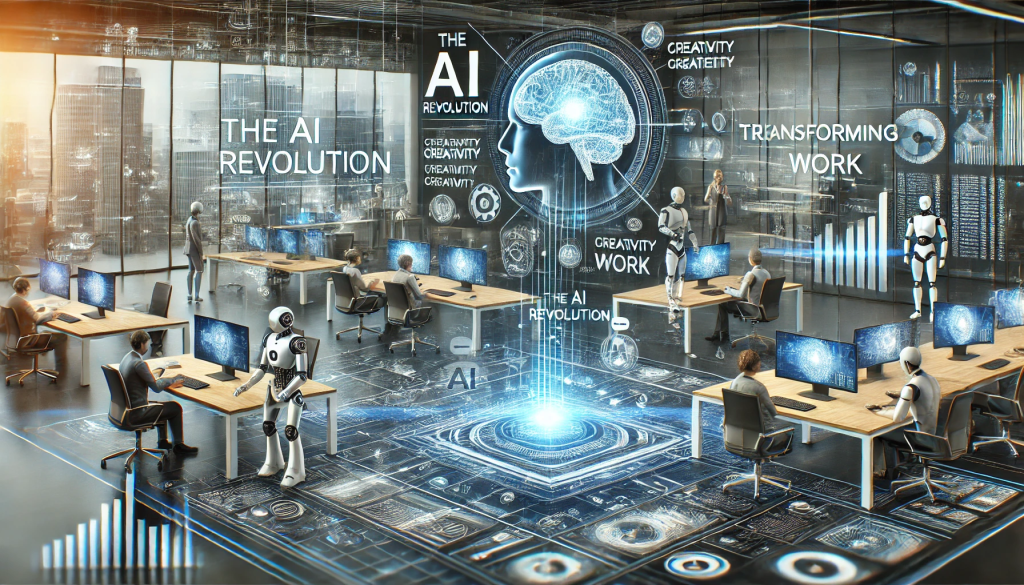
The AI Revolution: Transforming the Modern Workplace into a Hub of Innovation and Efficiency
From Assembly Lines to Algorithms: How AI is Redefining Work
Imagine a workplace where mundane tasks are handled by machines, data flows seamlessly to inform decisions, and employees are free to focus on creativity, strategy, and innovation. This is not a distant utopia—it’s the reality of the modern workplace, transformed by artificial intelligence (AI). Like a master conductor orchestrating a symphony, AI harmonises the cacophony of tasks, data, and human potential into a cohesive, high-performing ensemble.
AI is not just a tool but a transformative force reshaping the workplace, driving efficiency, fostering skill development, and enabling strategic excellence—all while demanding a commitment to ethical practices and continuous learning.
The AI Advantage: Efficiency at Scale
Automating the Mundane
AI’s most immediate impact on the workplace is its ability to automate repetitive tasks. Think of AI as the ultimate assistant, tirelessly handling the tedious work that once consumed hours of human effort. From data entry to inventory management, AI-powered systems are freeing employees from the drudgery of routine tasks.
For example, Amazon’s warehouses are a testament to AI-driven automation. Robots navigate vast storage spaces, retrieving items with precision and speed, while human workers focus on higher-value tasks like quality control and process optimisation. This synergy between humans and machines is not just about efficiency—it’s about elevating the role of human workers.
Data-Driven Decision Making
In the information age, data is the new oil, and AI is the refinery. AI systems can analyse vast datasets in seconds, uncovering patterns and insights that would take humans months to identify. This capability is transforming decision-making processes across industries.
Take Coca-Cola, for instance. The beverage giant uses AI to analyse consumer data, predict market trends, and optimise its supply chain. By leveraging AI-driven insights, Coca-Cola can make informed decisions that enhance customer satisfaction and drive profitability.
Optimising Workflows
AI also streamlines workflows, ensuring that resources are allocated efficiently and processes are executed seamlessly. UPS, for example, uses AI-powered route optimisation software to reduce fuel consumption and delivery times. This not only boosts efficiency but also reduces the company’s environmental footprint.
Upskilling for the Future: The Human Element in an AI-Driven World
The Rise of New Skill Sets
As AI assumes control of routine tasks, the demand for new skill sets surges. Employees are now expected to develop competencies in data science, machine learning, and AI interaction. This shift is not a threat but an opportunity—a chance to evolve and thrive in a rapidly changing landscape.
Consider JPMorgan Chase, which has invested heavily in employee AI training programs. By equipping its workforce with AI literacy, the company is enhancing productivity and fostering a culture of continuous learning.
Generative AI: A Catalyst for Creativity
Generative AI tools like ChatGPT and DALL-E are opening new frontiers of creativity. These tools enable employees to generate content, design visuals, and even write code quickly and precisely. Far from replacing human creativity, generative AI is amplifying it, allowing workers to focus on higher-level strategic thinking.
Strategic Excellence: Navigating the AI Frontier
The Power of Execution
In the words of the ancient strategist Sun Tzu, “Strategy without tactics is the slowest route to victory.” This timeless wisdom holds in the age of AI. While having a brilliant AI strategy is essential, flawless execution separates the winners from the also-rans.
IBM Watson Health exemplifies this principle. By executing its AI strategy with precision, the company has revolutionised healthcare, enabling personalised treatment plans and improving patient outcomes.
Future-Proofing Through Innovation
Organisations must embrace a culture of innovation to remain competitive in an AI-driven world. This involves staying abreast of technological advancements, adapting strategies, and fostering an environment where experimentation is encouraged.
Ethical Imperatives: Security, Privacy, and Trust
Building Robust Security Measures
With great power comes great responsibility. As AI systems handle sensitive data, ensuring robust security measures is paramount. Privacy-by-design principles must be integrated into AI systems from the ground up, safeguarding employee and customer information.
Fostering Trust Through Transparency
Trust is the cornerstone of successful AI adoption. Organisations must prioritise transparency, providing employees with clear explanations of how AI tools work and how they impact workflows. Feedback mechanisms should be established to address concerns and refine AI systems.
The Competitive Edge: Leveraging AI for Success
Enhancing Customer Experience
AI is not just transforming internal processes—it’s also revolutionising customer interactions. Chatbots, personalised recommendations, and predictive analytics enhance customer experiences across industries.
Driving Strategic Decision-Making
AI’s analysis of complex datasets empowers leaders to make strategic decisions confidently. By leveraging AI-driven insights, organisations can identify opportunities, mitigate risks, and stay ahead of the competition.
Conclusion: Embracing the AI Revolution
The AI revolution is not a distant future—it’s here, and it’s profoundly reshaping the workplace. By automating tasks, making data-driven decisions, and fostering skill development, AI is unlocking new levels of efficiency and innovation.
However, the true power of AI lies not in the technology itself but in how organisations harness it. To thrive in this new era, businesses must:
1. **Develop a Clear AI Strategy**: Align AI initiatives with business objectives and establish measurable KPIs.
2. **Invest in Skills Development**: Equip employees with the tools and knowledge they need to succeed in an AI-driven world.
3. **Prioritise Ethics and Security**: Build trust through transparency, robust security measures, and ethical AI governance.
4. **Foster a Culture of Innovation**: Encourage continuous learning, experimentation, and adaptability.
The future belongs to those who embrace AI not as a threat but as an opportunity—a catalyst for growth, innovation, and human potential. The question is not whether AI will transform the workplace but how you will leverage it to shape your organisation’s destiny.
By taking these actionable steps, organisations can confidently navigate the AI revolution, transforming challenges into opportunities and paving the way for a thriving, future-proof workplace. The symphony of AI and human ingenuity is just beginning—let’s make it a masterpiece.
Have you ever considered vulnerability as a strength?
In today’s workplace, strategic vulnerability functions like a bridge. Although it may appear weak, these intentional gaps provide the flexibility to remain steadfast against pressures. Let’s explore how this transforms the landscape for organisations! #StrategicVulnerability#Leadership
Imagine a bridge designed to sway with the wind, not against it. That’s a strategic vulnerability in action. It’s not about showing weakness but about embracing it to enhance resilience. When leaders show their human side, it builds trust and opens up new avenues for innovation.
#WorkplaceDynamics
This is important because when leaders are strategically vulnerable, they create an environment where team members feel secure in expressing ideas, admitting mistakes, and learning from them. This openness can lead to innovative solutions and a culture of continuous improvement.
#Innovation
Here lies the true power: Strategic vulnerability not only withstands storms but also transforms them into opportunities. By acknowledging uncertainties, leaders foster collaboration and fortify the team. It involves converting perceived weaknesses into collective strengths.
#TeamStrength
So, the next time you consider vulnerability a flaw, remember that it is a strategic choice in leadership. It involves creating a flexible, resilient organisation that can adeptly navigate challenges. Let us embrace this counterintuitive principle and observe our organisations thrive!
In business, sports, military operations, and personal achievement, we frequently encounter a fascinating paradox: a mediocre strategy executed perfectly often outperforms a brilliant strategy executed poorly.
This insight leads us to a profound truth: the combination of sound strategy and flawless execution creates an almost unstoppable force for success.
This comprehensive exploration examines the art and science of formulating the right strategy and bringing it to life through impeccable execution.
AI’s integration into the workplace is not merely about automation; it’s about fostering a symbiotic relationship where AI enhances human capabilities, resulting in unprecedented efficiency and innovation.
As businesses navigate this transition, prioritising upskilling, security, and strategic training will be crucial.
Companies can gain a competitive advantage by correctly leveraging AI and cultivating a culture that values continuous learning and ethical, technological progression.
The journey with AI is ongoing, necessitating vigilance, education, and adaptability.
However, it promises a future where work is more fulfilling, efficient, and human-centric.
The text examines the crucial role of adaptability in effective leadership for 2025 and beyond.
It argues that adaptability, while essential, must be complemented by resilience, empathy, visionary thinking, digital literacy, and collaborative leadership to create a holistic approach.
The text explores these components individually, illustrating how they interact and contribute to organisational success.
Examples and case studies support the argument that cultivating these qualities fosters robust, adaptable organisations that can thrive in a rapidly changing world.
Examples and case studies support the argument that cultivating these qualities fosters robust, adaptable organisations that can thrive in a rapidly changing world.
In 2025, automation and AI will be intricately woven into everyday business processes.
Routine tasks—from screening job applicants to generating financial reports—are increasingly automated, allowing employees to focus on more creative, high-value work. Leaders must comprehend how to deploy these tools ethically and efficiently.
Over-reliance on AI without adequate oversight can lead to biases or errors that tarnish an organisation’s reputation.
Conversely, disregarding AI’s potential opens the door for competitors to surpass the company in efficiency and innovation.
Leaders who responsibly integrate AI use “human-in-the-loop” frameworks, ensuring that critical decisions or ethical considerations involve human judgment.
They also invest in ongoing training so employees remain relevant and equipped for an AI-driven world.
By achieving this balance, leaders demonstrate foresight and empathy, illustrating that they value both technological progress and the welfare of their workforce.
The Purpose of my Popular Lunchtime Masterclass for Leaders,, Executives, Solpreneurs and Creators on:
Mastering Effectiveness: Strategies for Achieving the Right Outcomes, The Art and Science of Effectiveness: A 60-Minute Mastermind Journey.
I designed this masterclass to empower participants to understand effectiveness and measure it.
I applied proven strategies for achieving outcomes in professional and personal contexts.
The session equips participants with outcome-oriented thinking and practical measurement tools to make informed decisions about what to continue, change, or abandon to drive results. -Nicos Paschali-




 Nicos Paschali, International Author, Designer & Facilitator of Learning Workshops. Mental Discipline Coach.
Reply