Happier Brain? Lasting Well-Being.
- Our ability to maintain positive states.
- Our ability to recover from negative states.
- Our ability to focus and avoid mind-wandering.
- Our ability to be generous.
 | Nicos Paschali on Transformative Leadership Stra… |
 | Yiannos on Transformative Leadership Stra… |
 | Go Read the learning… on Finding Balance in Your Life!… |
We reduce spending on Learning & Development while increasing the quality and employee satisfaction. Talk with us!
We help you develop or reconfigure a strategy direction contributing to mindful engagement.
We contribute to your learning and development challenge creating experiences and unique value. Short or long format workshops that matter & coaching programs. Face-to-face or live online!
We help the corporate talent increase efficient performance with measurable and relevant programs.
We help organisations plan & execute learning and development strategy to drive business outcomes. Lead today and tomorrow!
We help individuals to plan and organise their life to grow and be happier.
We help students and professionals speed up learning and absorb content more. We teach essential cognitive skills ( memory, attention, processing, and sequencing).
For the last 35 years, we found ways to push the boundaries to start a new curve right at the point of maturity. Keep re-inventing ourselves. By innovating, progressing and staying relevant in the future. We have helped leaders and organisations lead better than ever before. We helped individuals align their life with purpose and values. Moreover, feel better about them! We did that by addressing personal/business outcomes and organisational changes. And achieve more, through learning strategies, training programs & workshops, coaching and short talks. We link deliverables to personal/business outcomes and objectives.
Our clients enjoy the most modern 21st-century learning and development. Because of our continued drive to improve and accumulated experience. With up to date approaches, concepts, and methodologies. And we adapt them to today’s challenges. We work with great people, startups and established organisations. We work in many cultures and industries. Europe, UAE & Australasia. Short term engagement options.
During our everyday work, we have two competing emotions, one being what is right, and being what is easy. It is tough to make a proper decision when those feelings are competing against each other.
Our job is to raise the bar for the long term, sustained success, not for the short-term convenience. Short-term results are easy. You can threaten people, pay them more, or give them what they want, and you will get short-term results.
Achieving long-term results is much more difficult. It requires establishing and follow a code of behaviour. It requires providing accurate feedback. It requires delivering the consequences based on decisions that employees make. It requires that you hold people accountable, one of the areas of improvement.
All these need our courage to do the right thing.
If you have, then you’ll know how challenging and draining this can be.
A team without trust is not really a team: it is just a group of individuals, working together, often making disappointing progress. They may not share information, they might battle over rights and responsibilities, and they may not cooperate with one another. It doesn’t matter how capable or talented your people are, they may never reach their full potential if trust is not present.
However, when trust is in place, each individual in the team becomes stronger, because he or she is part of an effective, cohesive group. When people trust one another, the group can achieve truly meaningful goals.
So how can you, as a leader, help your team to build the trust that it needs to flourish? In this article, we’ll look at the issue of trust within teams, why it is important, and what you can do to build it.
Catch up with us and explore the possibility to bring the training and coaching programme “The Most Trusted Leader” in your organisation!
Well-Crafted Questions?
“Old conversations” often involve people putting forth positions and offering arguments to support those positions. One way to invite a new conversation—one intended not for winning but for understanding—is to craft questions that ask people to:
The questions we ask encourage participants to expand the range of experiences and information that they pay attention to and share with others.
The questions we ask encourage people to expand the range of experiences and information that they pay attention to and share with others. When participants speak from the full range of their thoughts and experiences, they begin to listen more fully to each other, they become genuinely interested in each other, and they develop greater trust in each other.
The questions we ask also lead participants to reflect in new ways on their own perspectives. When the armour required for debate is discarded—and when people set aside a mindset that searches for ways to support their own arguments and undermine the arguments of others—they gain understanding, not only about others but also about themselves.
People who come to us for help are members of activist or stakeholder groups who want to spend more energy pursuing their positive goals and less energy managing a frustrating and exhausting battle with opposing groups.
They may feel that their advocacy has been largely ineffective and that they have nothing to lose by trying a new approach to communicating with other participants in the conflict.
They may worry that current relationships characterised by mutual distrust and feelings of victimization could deteriorate, leading to deeper divisions or even violence. They may fear that an important opportunity will be lost if they don’t develop a way to work together.
The value of experiential learning is not limited to academic settings. Leading organizations are increasingly adopting cutting-edge experiential learning methodologies to effectively align leaders to strategy and develop the skills and capabilities they need to execute on it.
Get in touch with us today to open the conversation and learn how to bring outcome driven innovative learning and coaching to your organisation.
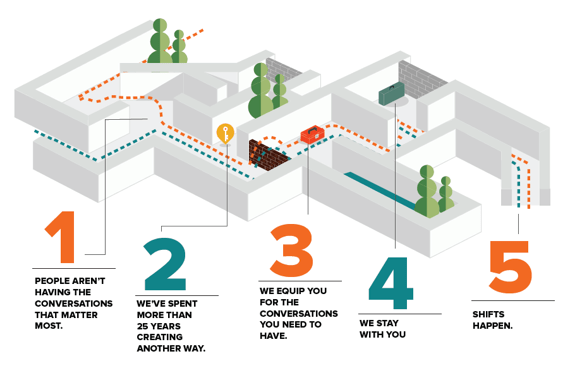
As people experience a new way of connecting across difference, they become better equipped and committed to building relationships and exploring new possibilities together.
They are willing and able to have the conversations that matter most.
Over time, we see that as communication habits shift, people begin to trust each other enough to come together, even in difficult moments. When that happens, people feel a greater sense of belonging to their community and trust that others – even those of different opinions, backgrounds or ideologies – are committed to helping their community thrive.
 Nicos Paschali, International Author, Designer & Facilitator of Learning Workshops. Mental Discipline Coach.
Reply