Guiding transformation means addressing every facet of leadership:
• Strategic Clarity: By aligning vision with actionable goals, guides help leaders see beyond day-to-day challenges. This strategic insight, often bolstered by tools like scenario planning and SWOT analysis, ensures that leaders remain focused on long-term impact.
• Deep Self-Awareness: Authentic leadership requires a deep understanding of one’s strengths, values, and areas for growth. Through reflective practices, continuous feedback, and self-assessment, guides help leaders unearth the core attributes that make them unique.
• Emotional Intelligence: Leaders must connect with their teams on a human level. The framework fosters emotional resilience and empathy and ensures that leaders can navigate conflicts, inspire trust, and build cohesive, motivated teams.
• Action-Oriented Execution: Transformational guides encourage leaders to translate insights into tangible actions. Whether setting measurable goals or celebrating progress, the approach empowers leaders to turn strategic visions into reality.
#HolisticLeadership – Embrace a comprehensive approach to leadership that integrates mind, heart, and action.
#StrategicClarity – Align your vision with actionable goals to drive long-term impact.
#DeepSelfAwareness – Unlock your unique strengths and values through reflection and growth.
#EmotionalIntelligence – Lead with empathy and resilience to inspire and unite your team.
#ActionOrientedGrowth – Turn insights into impactful actions for transformative results.
#AuthenticLeadership – Lead from your core, with clarity, purpose, and authenticity.
#TransformationalGuides – Empowering leaders to navigate challenges and achieve greatness.
#MindHeartAction – Integrate every facet of leadership for sustainable success.
#EmpathyInLeadership – Build trust and cohesion through emotionally intelligent leadership.
10. #VisionToReality – Transform strategic visions into measurable, meaningful outcomes.
The Imperative of AI in Modern Business: A Call to Action for CEOs
February, 2025
Dear CEO,
In the dynamic landscape of 2025, integrating Artificial Intelligence (AI) into your company’s workflow is not just an advantage; it’s necessary for survival and growth. The era of AI as a luxury or a distant tech dream has ended. It’s the cornerstone of innovation, efficiency, and competitive edge. Here’s why you, as a leader, must act decisively to incorporate AI into your strategy today:
1. Unmatched Efficiency:
AI automates mundane tasks, from data analysis to customer service interactions, freeing your human talent to focus on creativity and strategic decision-making. This translates into higher productivity and a more motivated workforce.
– Example: AI has reduced stock management time by over 70% in retail, allowing staff to focus on customer engagement.
2. Data-Driven Decisions:
AI turns raw data into insights quickly and accurately, enabling decisions based on real-time analysis rather than gut feeling.
– Insight: AI can predict market trends, helping in strategic planning with unprecedented precision.
3. Customer Experience Revolution:
Personalisation is key in today’s market, and AI delivers personalised experiences at scale, enhancing customer loyalty and satisfaction.
– Impact: Companies like Amazon leverage AI to tailor recommendations, increasing sales and customer retention.
4. Innovation at Scale:
AI isn’t just about efficiency; it’s about pioneering new products, services, or even business models that were previously unimaginable.
– Case Study: Tesla uses AI for autonomous driving and designing more efficient manufacturing processes.
5. Cost Reduction:
AI significantly reduces waste and operational costs by optimising operations and predicting maintenance needs.
– Financial Benefit: AI can lead to up to 30% savings in operational costs through better resource management.
6. Enhanced Security:
AI provides a proactive defense against cyber threats, continuously learning and adapting to new forms of attack.
– Security: AI systems like those developed by IBM can detect anomalies in network traffic, safeguarding data integrity.
7. Scalability:
As your business grows, AI scales with it, managing increased complexity without the proportional increase in human effort or error.
The Call to Action:
The time to integrate AI into your workflow is now. Lead your company into the future, not just by keeping pace but by setting the pace. Start small if necessary, but start today.
– Invest in AI Talent: Whether by training or hiring, ensure you have the expertise to leverage AI effectively.
– Educate Your Team: AI should augment, not replace, human capabilities. Foster an AI-friendly culture.
– Ethical AI: Commit to ethical practices in AI deployment, focusing on transparency and fairness.
In conclusion, AI is not a luxury but a strategic imperative. By embracing AI now, you’re not just preparing for the future but actively shaping it. Let’s make AI part of your workflow and the core of your vision for a brighter, more efficient, and innovative company.
The Art of Conversation: Your Key to Unlocking Success
Nicos Paschali, February 2025
Mastering Communication for Personal and Professional Triumph
Imagine transforming every conversation into an opportunity for growth, influence, and connection. What if your words could convey your thoughts and elevate your life and career to new heights?
Effective communication is not just a skill but a powerful tool that, when mastered, can dramatically enhance your relationships, propel your professional achievements, and open doors to endless opportunities.
Personal Success:
Relationship Building:
Trust and Understanding: Effective communication fosters trust and mutual understanding, which is essential for strong personal relationships.
Conflict Resolution: The ability to express oneself clearly and listen actively helps resolve conflicts amicably, preserving relationships.
Self-Expression and Emotional Health:
Authenticity: Good communicators can express their thoughts, feelings, and needs more authentically, leading to greater personal satisfaction and self-esteem.
Emotional Intelligence: Effective communication is both a product and a builder of emotional intelligence, aiding in better emotional regulation and empathy.
Personal Development:
Learning and Growth: Communicating effectively with mentors or peers or through self-reflection supports personal learning and growth.
Networking: The ability to communicate well expands one’s social network, opening doors to new opportunities, knowledge, and experiences.
Professional Success:
Leadership and Management:
Influence and Motivation: Leaders who communicate effectively can inspire and motivate their teams, driving productivity and innovation.
Decision Making: Clear communication ensures that decisions are understood, supported, and executed efficiently across an organisation.
Team Collaboration:
Cohesion: Effective team communication leads to better collaboration, reducing misunderstandings and fostering a united work environment.
Efficiency: When teams communicate well, projects run smoother with fewer delays due to miscommunication.
Career Advancement:
Visibility: Being a good communicator often means your ideas and contributions are more visible to decision-makers, potentially leading to promotions or new opportunities.
Client Relations: In roles that involve client interaction, effective communication can lead to stronger client relationships, repeat business, and referrals.
Negotiation and Problem Solving:
Negotiation Skills: The art of negotiation is deeply tied to communication, where clarity, persuasion, and listening skills can lead to better outcomes.
Problem-Solving: Articulating problems, brainstorming solutions, and discussing them effectively with others enhance problem-solving capabilities.
Cultural Competence:
Diverse Workplaces: In global or diverse workplaces, effective cross-cultural communication reduces friction, fosters inclusivity, and leverages diverse perspectives for better outcomes.
Broader Impacts:
Reputation: How you communicate shapes your reputation, both personally and professionally. Effective communicators are often seen as more competent, reliable, and likeable.
Conflict Reduction: Effective communication can mitigate organisational conflicts on a larger scale, leading to a healthier work culture and higher employee satisfaction.
Innovation: Open and transparent communication channels encourage the sharing of ideas, which is vital for innovation and staying competitive in any field.
In essence, effective communication acts as a multiplier of success, enhancing every interaction and relationship, whether it’s with family, friends, colleagues, or clients. It’s not just about speaking well but about listening, understanding, and responding in ways that foster mutual respect and achievement. This alignment with Nicos Paschali’s approach, which emphasises emotional intelligence alongside technical skill, underscores why communication is pivotal in his transformative learning initiatives.
Unleash Your Extraordinary Potential: Transform Your Life and Leadership with Nicos Paschali
Embark on a Transformative Journey to Redefine Success, Innovate Fearlessly, and Lead with Unparalleled Vision
As a client working with Nicos Paschali, you can expect to experience a transformative journey that yields significant personal and professional benefits. Here’s what you can anticipate:
Tailored Guidance and Expertise
– Benefit: You receive personalised strategies that address your specific challenges and goals.
– Experience: Nicos draws from his vast experience across multiple domains to provide you with innovative and practical insights.
Enhanced Communication Skills
– Benefit: You’ll develop the ability to communicate more effectively in various professional and personal settings.
– Experience: Through Nicos’ precision communication techniques and storytelling methods, you’ll learn to articulate your ideas with clarity and impact.
Accelerated Personal Growth
– Benefit: You’ll experience rapid development in areas crucial for your success.
– Experience: Nicos’ “Transformative Actionable Learning” approach ensures that you gain knowledge and apply it immediately for tangible results.
Increased Emotional Intelligence
– Benefit: You’ll improve your ability to understand and manage emotions, both your own and others.
– Experience: Nicos’ empathetic approach and focus on deep connections will help you develop stronger interpersonal skills and leadership qualities.
Innovative Problem-Solving
– Benefit: You’ll gain new perspectives on challenges and develop creative solutions.
– Experience: Nicos’ integration of cutting-edge technologies and cross-disciplinary insights will expand your problem-solving toolkit.
Sustainable Performance Improvement
– Benefit: You’ll improve your performance and productivity.
– Experience: The focus on transformative learning ensures that the changes you make are deeply ingrained and sustainable over time.
Enhanced Leadership Capabilities
– Benefit: You’ll develop a more effective and inspiring leadership style.
– Experience: By learning from Nicos’ visionary approach and adaptable strategies, you’ll become a more impactful leader in your organisation.
Global Perspective
– Benefit: You’ll gain relevant insights in an increasingly interconnected world.
– Experience: Nicos’ international experience allows you to benefit from a global perspective, enhancing your cross-cultural competence.
Technological Edge
– Benefit: You’ll learn how to leverage technology for personal and organisational growth.
– Experience: Nicos’ background in AI and computer science provides you with insights on integrating cutting-edge technologies into your strategies.
Continuous Learning Mindset
– Benefit: You’ll develop habits for ongoing personal and professional development.
– Experience: Nicos’ commitment to lifelong learning will inspire you to continually seek new knowledge and skills.
By engaging with Nicos Paschali, you’re not just receiving a service; you’re embarking on a transformative journey that will elevate your capabilities, broaden your perspective, and empower you to achieve exceptional outcomes in your personal and professional life.
The Leadership Imperative: Rethinking Strategy for Competitive Advantage with Blue Ocean Strategy
Set Sail for Uncharted Waters – Embrace Blue Ocean Innovation to Redefine Markets and Outpace the Competition.
Nicos Paschali, February 2025
Set sail for uncharted waters—where innovation transforms competitive pressure into opportunities for groundbreaking growth.
By shifting focus from traditional cost-cutting to value innovation, organisations can create uncontested market spaces that redefine industry norms and secure sustainable competitive advantage.
In today’s dynamic business landscape, the traditional focus on cost-cutting and efficiency as the sole drivers of competitive advantage is becoming increasingly outdated. While operational efficiency remains essential, building a sustainable edge in the marketplace is no longer sufficient. Instead, leaders must embrace a strategy that centres on innovation across products, business models, customer experiences, and industry norms. One robust framework for achieving this is the Blue Ocean Strategy, which shifts the focus from competing in crowded markets to creating uncontested market space.
From Red Oceans to Blue Oceans
Historically, many organisations have concentrated on competing in “red oceans,” where the market is saturated with similar offerings. The primary focus is on beating the competition—often through cost reduction. However, as noted by Kim and Mauborgne, the architects of the Blue Ocean Strategy, red oceans are defined by fierce competition, shrinking profits, and relentless rivalry. The provided text underscores this shift by stating that “a sustainable competitive advantage cannot be built solely on efficiency. Cost-cutting is necessary but insufficient.”
Blue Ocean Strategy advocates for creating “blue oceans”—untapped market spaces ripe for innovation, where competition is rendered irrelevant. Organisations are encouraged to redefine market boundaries instead of fighting over a finite customer base, thereby unlocking new demand and making the competition immaterial. This paradigm shift calls for a commitment to breakthrough innovations that create new value rather than merely optimising the past.
Key Pillars of an Innovation-Driven, Blue Ocean-Inspired Strategy
To assess whether your organisation’s strategy is genuinely innovation-driven and in line with Blue Ocean principles, consider these guiding questions:
1. Does our strategy create new value, or does it primarily focus on reducing costs?
A blue ocean move is about value innovation—simultaneously pursuing differentiation and low cost. Companies can create offerings that redefine customer expectations by challenging the status quo and exploring new value curves, much like how Cirque du Soleil reinvented the circus industry.
2. Are we actively challenging industry assumptions or competing within existing frameworks?
Innovation requires questioning long-held assumptions about how business should be done. Blue Ocean Strategy invites organisations to break free from conventional boundaries and explore new possibilities. This approach involves identifying what factors the industry has long competed on and then reimagining these elements to offer unprecedented value.
3. Are we innovating at multiple levels of business model, operations, and customer experience?
Strategic innovation should be comprehensive. Beyond mere product improvements, blue ocean thinking requires a holistic transformation across the business. This might include reconfiguring the supply chain, rethinking the customer journey, or altering the revenue model to capture new forms of value.
4. Do we have mechanisms for continuous strategic experimentation and adaptation?
In a rapidly evolving market, agility is paramount. Organisations must implement robust feedback loops, invest in R&D, and foster a culture of experimentation. A blue ocean mindset is not a one-off initiative; it requires ongoing refinement and adaptation to maintain a competitive edge.
The Business Case for a Blue Ocean Approach
Investing in innovation and value creation through a blue ocean approach offers significant rewards. Take, for example, the success stories of companies like Apple and Tesla. These organisations did not merely focus on cost efficiency; they redefined entire industries by offering products and services that created new market spaces. Apple’s emphasis on design and user experience and Tesla’s pioneering of electric vehicles and sustainable energy solutions are prime examples of how blue ocean moves can lead to market leadership.
Research supports this strategic shift. A study published in the Harvard Business Review indicates that companies engaging in blue ocean strategies tend to enjoy higher growth rates and profitability than their peers locked in red ocean competition. Traditional market constraints do not limit these companies but are free to explore and exploit new demand and value propositions.
Building a Culture of Blue Ocean Innovation
Transitioning to a blue ocean strategy is not merely about adopting a new business model—it requires a fundamental cultural transformation. Leaders must cultivate an environment that nurtures creativity, embraces risk, and encourages cross-functional collaboration. Here are some key steps to build a blue ocean culture:
• Invest in Talent and Continuous Learning:
Equip employees with the skills and knowledge needed to think outside the box. This might involve training programs, innovation labs, or partnerships with academic institutions that foster creative problem-solving.
• Empower Cross-Functional Teams:
Break down silos within the organisation to allow diverse teams to collaborate and generate innovative ideas. Companies can tap into a wide range of perspectives that fuel breakthrough innovations by creating open dialogue and experimentation spaces.
• Adopt Agile Methodologies:
Implement agile frameworks that enable rapid prototyping, testing, and iteration. This approach accelerates the innovation process and ensures that the organisation remains responsive to changing market dynamics.
• Leverage Data and Technology:
Utilise advanced analytics and digital tools to gain insights into emerging trends and customer behaviour. Data-driven decision-making can help identify untapped market opportunities and refine strategic initiatives in real-time.
Conclusion
The future of strategic leadership lies in the ability to transcend traditional paradigms and embed innovation into every facet of organisational strategy. As the initial text articulates, “Those who embrace strategy as a blueprint for differentiation position themselves for long-term success. As markets evolve, the organisations that thrive will not be those that optimise the past—they will be the ones that invent the future.”
By integrating Blue Ocean Strategy principles—focusing on value innovation, challenging industry norms, and pursuing a holistic transformation—leaders can unlock new market spaces and create sustainable competitive advantages. This shift from a cost-centric approach to continuous innovation positions organisations for long-term success and ensures they remain adaptable in an era marked by rapid technological and market changes.
Embracing the blue ocean mindset is not merely a strategic option but a necessity for survival and success in today’s competitive landscape. Organisations can drive growth, foster resilience, and secure a lasting competitive edge in an ever-evolving marketplace by committing to reinventing the future and creating uncontested market space.
Creating new growth instead of competing for existing market share involves several strategic approaches. Here are some key methods:
Innovation:
Product Innovation involves Developing new products or significantly enhancing existing ones to meet unmet needs or create new markets. For example, Apple’s introduction of the iPhone created a new category of smartphones and redefined consumer expectations.
Process Innovation involves Improving how products are made, or services are delivered. This can open up new markets or significantly reduce costs (e.g., Tesla’s advancements in battery technology).
Blue Ocean Strategy:
Instead of fighting over a shrinking pool of customers in a “red ocean,” seek to create “blue oceans” of uncontested market space. This means looking for or creating new demand where there are no competitors yet.
Examples include Cirque du Soleil, which combined circus arts with theatre, thus creating a new entertainment category.
Market Expansion:
Geographic Expansion: Enter new markets where your product or service isn’t yet available. This could mean international expansion or targeting different demographic segments within existing markets.
Diversification: Explore different industries or sectors where your company’s core competencies can be leveraged.
Customer-Centric Innovation:
Listen to the customer’s voice to identify what they want now and might need in the future. This can lead to creating solutions for problems customers didn’t know they had.
Implement a culture of continuous feedback where customer insights directly influence product development.
Disruptive Business Models:
Think like a disruptor by changing how business is done in your industry. For instance, Netflix pioneered streaming services and disrupted traditional video rental.
Subscription, freemium, or platform-based business models can change the competition dynamics.
Technology Utilization:
Leverage cutting-edge technology like AI, IoT, blockchain, etc., to create new business models or to enhance products or services. This can lead to new ways of interacting with customers or managing supply chains.
Partnerships and Ecosystems:
Build ecosystems where companies collaborate to create more value than they could alone. This can be done through strategic alliances, co-innovation, or platforms that benefit multiple parties.
Sustainability and Social Impact:
Companies focusing on sustainability or social impact can capitalise on growing consumer trends toward ethical consumption, opening up new markets or niches.
Educating the Market:
Sometimes, new growth comes from educating consumers about new possibilities or benefits they weren’t aware of, thus creating demand for your product.
Implementing these strategies requires a culture that values innovation, risk-taking, and long-term vision over short-term gains. Leadership must be committed to exploring new avenues, even if it means diverting resources from current profitable operations. The key is not just reacting to market conditions but shaping them proactively through pioneering efforts.
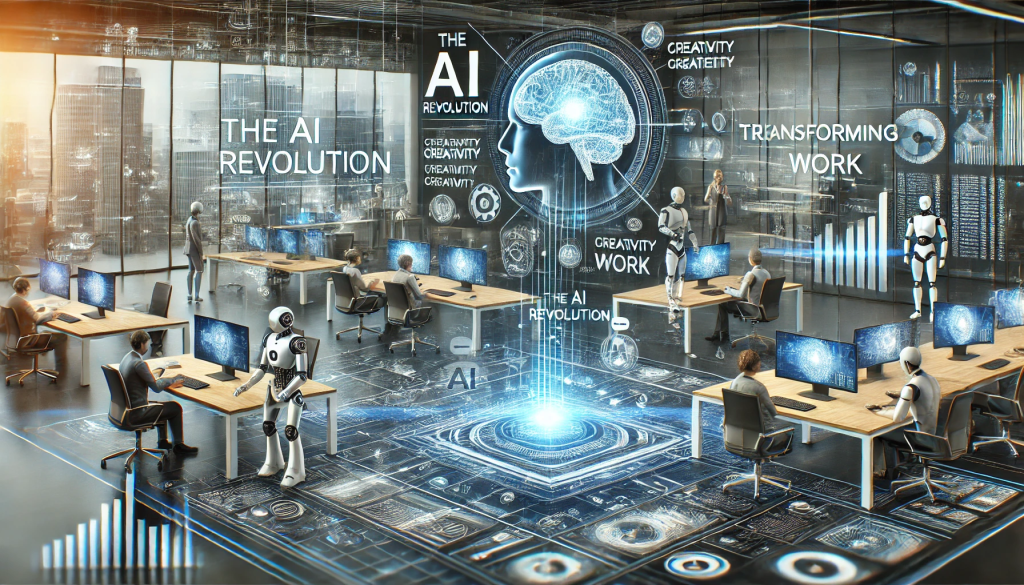
The AI Revolution: Transforming the Modern Workplace into a Hub of Innovation and Efficiency
From Assembly Lines to Algorithms: How AI is Redefining Work
Imagine a workplace where mundane tasks are handled by machines, data flows seamlessly to inform decisions, and employees are free to focus on creativity, strategy, and innovation. This is not a distant utopia—it’s the reality of the modern workplace, transformed by artificial intelligence (AI). Like a master conductor orchestrating a symphony, AI harmonises the cacophony of tasks, data, and human potential into a cohesive, high-performing ensemble.
AI is not just a tool but a transformative force reshaping the workplace, driving efficiency, fostering skill development, and enabling strategic excellence—all while demanding a commitment to ethical practices and continuous learning.
The AI Advantage: Efficiency at Scale
Automating the Mundane
AI’s most immediate impact on the workplace is its ability to automate repetitive tasks. Think of AI as the ultimate assistant, tirelessly handling the tedious work that once consumed hours of human effort. From data entry to inventory management, AI-powered systems are freeing employees from the drudgery of routine tasks.
For example, Amazon’s warehouses are a testament to AI-driven automation. Robots navigate vast storage spaces, retrieving items with precision and speed, while human workers focus on higher-value tasks like quality control and process optimisation. This synergy between humans and machines is not just about efficiency—it’s about elevating the role of human workers.
Data-Driven Decision Making
In the information age, data is the new oil, and AI is the refinery. AI systems can analyse vast datasets in seconds, uncovering patterns and insights that would take humans months to identify. This capability is transforming decision-making processes across industries.
Take Coca-Cola, for instance. The beverage giant uses AI to analyse consumer data, predict market trends, and optimise its supply chain. By leveraging AI-driven insights, Coca-Cola can make informed decisions that enhance customer satisfaction and drive profitability.
Optimising Workflows
AI also streamlines workflows, ensuring that resources are allocated efficiently and processes are executed seamlessly. UPS, for example, uses AI-powered route optimisation software to reduce fuel consumption and delivery times. This not only boosts efficiency but also reduces the company’s environmental footprint.
Upskilling for the Future: The Human Element in an AI-Driven World
The Rise of New Skill Sets
As AI assumes control of routine tasks, the demand for new skill sets surges. Employees are now expected to develop competencies in data science, machine learning, and AI interaction. This shift is not a threat but an opportunity—a chance to evolve and thrive in a rapidly changing landscape.
Consider JPMorgan Chase, which has invested heavily in employee AI training programs. By equipping its workforce with AI literacy, the company is enhancing productivity and fostering a culture of continuous learning.
Generative AI: A Catalyst for Creativity
Generative AI tools like ChatGPT and DALL-E are opening new frontiers of creativity. These tools enable employees to generate content, design visuals, and even write code quickly and precisely. Far from replacing human creativity, generative AI is amplifying it, allowing workers to focus on higher-level strategic thinking.
Strategic Excellence: Navigating the AI Frontier
The Power of Execution
In the words of the ancient strategist Sun Tzu, “Strategy without tactics is the slowest route to victory.” This timeless wisdom holds in the age of AI. While having a brilliant AI strategy is essential, flawless execution separates the winners from the also-rans.
IBM Watson Health exemplifies this principle. By executing its AI strategy with precision, the company has revolutionised healthcare, enabling personalised treatment plans and improving patient outcomes.
Future-Proofing Through Innovation
Organisations must embrace a culture of innovation to remain competitive in an AI-driven world. This involves staying abreast of technological advancements, adapting strategies, and fostering an environment where experimentation is encouraged.
Ethical Imperatives: Security, Privacy, and Trust
Building Robust Security Measures
With great power comes great responsibility. As AI systems handle sensitive data, ensuring robust security measures is paramount. Privacy-by-design principles must be integrated into AI systems from the ground up, safeguarding employee and customer information.
Fostering Trust Through Transparency
Trust is the cornerstone of successful AI adoption. Organisations must prioritise transparency, providing employees with clear explanations of how AI tools work and how they impact workflows. Feedback mechanisms should be established to address concerns and refine AI systems.
The Competitive Edge: Leveraging AI for Success
Enhancing Customer Experience
AI is not just transforming internal processes—it’s also revolutionising customer interactions. Chatbots, personalised recommendations, and predictive analytics enhance customer experiences across industries.
Driving Strategic Decision-Making
AI’s analysis of complex datasets empowers leaders to make strategic decisions confidently. By leveraging AI-driven insights, organisations can identify opportunities, mitigate risks, and stay ahead of the competition.
Conclusion: Embracing the AI Revolution
The AI revolution is not a distant future—it’s here, and it’s profoundly reshaping the workplace. By automating tasks, making data-driven decisions, and fostering skill development, AI is unlocking new levels of efficiency and innovation.
However, the true power of AI lies not in the technology itself but in how organisations harness it. To thrive in this new era, businesses must:
1. **Develop a Clear AI Strategy**: Align AI initiatives with business objectives and establish measurable KPIs.
2. **Invest in Skills Development**: Equip employees with the tools and knowledge they need to succeed in an AI-driven world.
3. **Prioritise Ethics and Security**: Build trust through transparency, robust security measures, and ethical AI governance.
4. **Foster a Culture of Innovation**: Encourage continuous learning, experimentation, and adaptability.
The future belongs to those who embrace AI not as a threat but as an opportunity—a catalyst for growth, innovation, and human potential. The question is not whether AI will transform the workplace but how you will leverage it to shape your organisation’s destiny.
By taking these actionable steps, organisations can confidently navigate the AI revolution, transforming challenges into opportunities and paving the way for a thriving, future-proof workplace. The symphony of AI and human ingenuity is just beginning—let’s make it a masterpiece.
Have you ever considered vulnerability as a strength?
In today’s workplace, strategic vulnerability functions like a bridge. Although it may appear weak, these intentional gaps provide the flexibility to remain steadfast against pressures. Let’s explore how this transforms the landscape for organisations! #StrategicVulnerability#Leadership
Imagine a bridge designed to sway with the wind, not against it. That’s a strategic vulnerability in action. It’s not about showing weakness but about embracing it to enhance resilience. When leaders show their human side, it builds trust and opens up new avenues for innovation.
#WorkplaceDynamics
This is important because when leaders are strategically vulnerable, they create an environment where team members feel secure in expressing ideas, admitting mistakes, and learning from them. This openness can lead to innovative solutions and a culture of continuous improvement.
#Innovation
Here lies the true power: Strategic vulnerability not only withstands storms but also transforms them into opportunities. By acknowledging uncertainties, leaders foster collaboration and fortify the team. It involves converting perceived weaknesses into collective strengths.
#TeamStrength
So, the next time you consider vulnerability a flaw, remember that it is a strategic choice in leadership. It involves creating a flexible, resilient organisation that can adeptly navigate challenges. Let us embrace this counterintuitive principle and observe our organisations thrive!
It guides decisions about what to continue, change, or abandon.
Effectiveness refers to the extent to which something successfully achieves a desired outcome. Here’s a breakdown of the concept:
Outcome-Oriented: Effectiveness emphasises outcomes over the process. It concerns whether the goals or objectives are achieved, irrespective of the methods employed.
Measurement: Effectiveness can be gauged by comparing the actual results to the intended or expected outcomes. In business, effectiveness may be assessed through market share, customer satisfaction, or revenue growth related to goals.
Context-Specific: Adequacy standards can differ significantly based on the context or field. For example:
In education, effectiveness may reflect how well students learn or perform in assessments.
In medicine, it might indicate how effectively a treatment cures or manages a condition.
Software development could be evaluated by how well the software meets user needs or operates under various conditions.
Efficiency vs. Effectiveness: While related, these concepts are distinct. Efficiency concerns how healthy resources are utilised to achieve outcomes (doing things right), whereas effectiveness focuses on achieving the proper outcomes (doing the right things).
Factors Influencing Effectiveness:
1. Clarity of Goals: Well-defined and clear goals simplify effectiveness measurement.
2. Resource Allocation: Proper allocation of resources (time, money, personnel) is crucial for goal achievement.
3. Adaptability: The capacity to modify strategies in response to evolving circumstances or feedback.
4. Evaluation: A systematic evaluation or review process is typically required to determine effectiveness. This process often involves feedback loops, performance metrics, or external audits.
When discussing effectiveness, we are referring to how successful an approach, strategy, tool, or individual is at achieving specific, predetermined results. It serves as a key performance indicator in various professional and personal endeavours, guiding decisions on what to continue, change, or abandon.
Nicos Paschali has achieved the following in the field of executive coaching:
● Pioneered AI-integrated coaching methodologies for enhanced program delivery:
sPaschali is a leader in integrating AI and technology into executive coaching. This innovative approach likely enhances program delivery by personalizing coaching experiences, providing data-driven insights, and improving the efficiency of coaching programs.
● Developed proprietary “Must-Have Method” for sustainable leadership development:
This suggests that Paschali has created a unique and effective framework for developing leadership skills that lead to long-term success.
● Successfully scaled operations across multiple international markets:
Paschali has a proven track record of growing and expanding his coaching practice into new regions, including Europe, the UAE, and Australasia.This demonstrates his ability to adapt his coaching approaches to different cultural contexts and build successful businesses in diverse markets.
● Established a proven track record of transformative client outcomes:
Paschali’s coaching programs consistently deliver positive results for his clients, helping them achieve significant personal and professional growth.
● Built and maintained a global network of high-profile corporate clients:
Paschali’s success in attracting and retaining high-profile clients speaks to the quality and effectiveness of his coaching services.
Paschali’s focus on innovation, technology integration, and delivering measurable results has established him as a leader in executive coaching. His achievements highlight his commitment to helping leaders achieve sustainable growth and success.






 Nicos Paschali, International Author, Designer & Facilitator of Learning Workshops. Mental Discipline Coach.
Reply