Tagged: coaching Toggle Comment Threads | Keyboard Shortcuts

  • Unknown's avatar

    Nicos Paschali 8:16 am on November 6, 2024 Permalink | Reply
    Tags: , coaching, , , , startup   

    Launchpad: Propel Your Entrepreneurial Journey Forward! 

    Transformative Journey: Empowering Teens to Become Entrepreneurs

    Unleash your potential and embark on your entrepreneurial journey. Let this launchpad inspire you as you fuel your passion and transform your ideas into reality. Start your journey today!

    Purpose and Aim:

    The core program, Fundamentals,  aims to empower high school students in eight weeks with sufficient knowledge, skills, and confidence to transform their ideas into successful businesses. We strive to nurture the next generation of entrepreneurs by providing a comprehensive, hands-on learning experience that connects classroom theory with practical, real-world applications.

    The Fundamentals program provides teenagers with essential tools and a mindset to navigate the exciting world of entrepreneurship and turn their innovative ideas into viable business ventures.

    With Launch Pad, you can turn your passion into a successful business before high school graduation. Our program helps teens turn their love for baking into a thriving online cupcake business or develop a popular eco-friendly smartphone app.

    What’s your big idea?

    8 Weeks

    Each week includes interactive workshops, mentorship sessions, reading material and learning guides.

    Every Tuesday 7.00-8.30 pm

    10, 17, 31/12 2024, 14, 21, 28/2024, 4,11/2 2025

    Fees  €750 payable with registration

    Early bird €640 by 12/11/2024 

    Registration and payment form: https://forms.gle/wVk8f8wmKJsi6UVx7

    Program Outline

     Week 1: Unleashing Your Entrepreneurial Spirit

    • Ignite Your Imagination: Dive into the possibilities as you brainstorm and unleash your unique business ideas.
    • Discover Your Market: Learn the art of market research and uncover the needs of your future customers.
    • Deep dive into Artificial Intelligence.

     Week 2: Crafting Your Vision

    • Building Your Business Blueprint: Transform your ideas into a solid business model that reflects your passions and values.
    • Financial Foundations: Understand the basics of budgeting and funding, laying the groundwork for your entrepreneurial journey.

     Week 3: Marketing Magic

    • Create Your Brand Story: Learn how to craft a compelling brand that resonates with your audience and stands out in the marketplace.
    • Engage Your Customers: Master innovative marketing strategies that captivate and connect with potential customers.

     Week 4: Mastering Operations

    • Running the Show: Explore the essentials of operations management, ensuring your business runs smoothly and efficiently.
    • Leadership Skills for Tomorrow: Develop the leadership qualities to inspire your team and drive your vision forward.

     Week 5: Ethics and Responsibility

    • Building a Business with Integrity: Understand the importance of ethical practices and social responsibility in today’s business landscape.
    • Navigating Legal Waters: Gain insights into the legal aspects of running a business, empowering you to make informed decisions.

     Week 6: Launching Your Dream

    • Preparing for Takeoff: Get ready to confidently launch your business, armed with everything you need for success.
    • Growth Mindset Strategies: Embrace a mindset that welcomes challenges and fosters continuous improvement as you scale your venture.

     Weeks 7-8: Bringing Ideas to Life (Student Presentations)

    • Real-World Application: Collaborate with peers to develop a comprehensive business plan or prototype that embodies your vision.
    • Pitch Perfect: Hone your presentation skills as you prepare to share your entrepreneurial journey with peers, mentors, and potential investors.

    Keep your age from becoming the next prominent entrepreneur. Join Launch Pad today and take the first step towards building your empire. With limited spots available, secure your place and start your journey from student to CEO. Please register online or call us to learn how to turn your passion into profit. Your future in business starts here – are you ready to launch?

    You may register here: https://forms.gle/wVk8f8wmKJsi6UVx7

    Ask Anything at nicospas@gmail.com
     
  • Unknown's avatar

    Nicos Paschali 7:20 am on November 1, 2024 Permalink | Reply
    Tags: , coaching, , , ,   

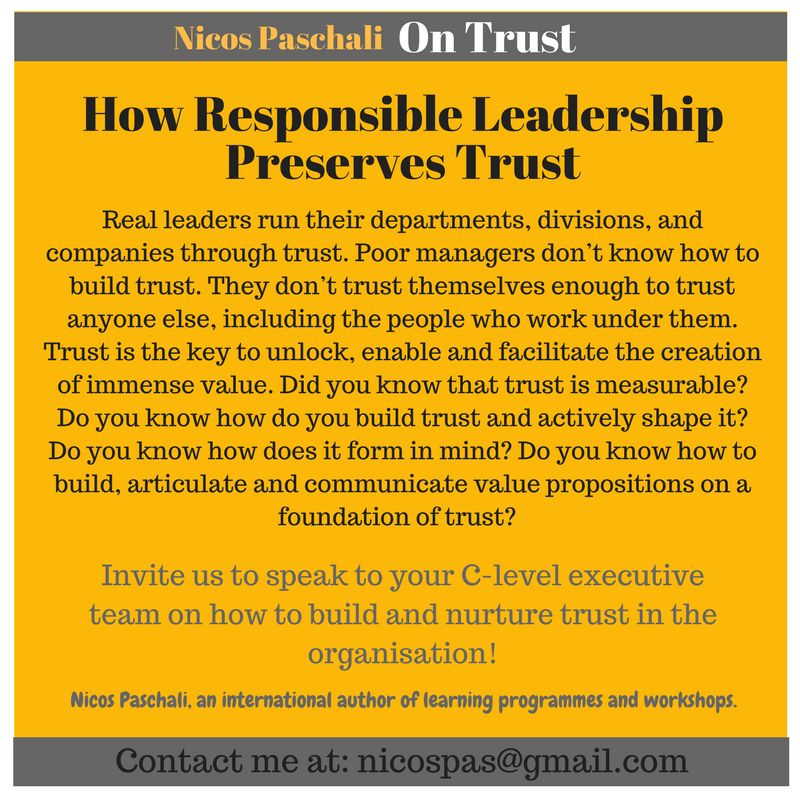
    Study Guide: Communicating and Building Trust 

    Study Guide: Communicating and Building Trust

    This study guide is based on the provided text excerpts, which focus on the importance of trust in leadership and organisational success.

    Central Questions to Review:

    1. Why is trust crucial for effective leadership? What are the specific benefits of trust in a leadership context? What are the consequences of a lack of confidence?
    2. How can leaders build trust within their organisations? What specific actions and behaviours contribute to building trust? Consider the role of self-trust, understanding trust formation, and communication.
    3. How can trust be measured within an organisation? What are some potential methods and metrics for assessing trust levels? Why is measuring trust important?
    4. How can leaders maintain and preserve trust once it has been established? What potential threats to trust, and how can they be mitigated?
    5. What is the relationship between responsible leadership and trust? How do self-awareness, communication, and continuous learning concepts relate to responsible leadership and trust-building?
    6. How can external expertise be leveraged to enhance trust-building initiatives within an organisation? What specific benefits can experts like Nicos Paschali offer?

    Glossary of Key Terms and Ideas:

    • Trust: A firm belief in the reliability, truth, ability, or strength of someone or something. In a leadership context, trust refers to employees’ confidence in their leaders and the organisation as a whole.
    • Self-Trust: Trust in one’s abilities, judgment, and instincts. The text emphasises that self-trust is a prerequisite for trusting others.
    • Value Propositions: The benefits an organisation promises its customers or stakeholders. In the context of trust, leaders must communicate their value propositions in a way that reinforces trust and integrity.
    • Transparency and Openness: Clear, honest, and accessible communication that promotes understanding and reduces uncertainty.
    • Active Listening and Empathy: Communication skills involve paying close attention to what others are saying, seeking to understand their perspectives, and responding with empathy and respect.
    • Consistency in Messaging and Actions: Aligning one’s words with one’s actions. Consistency builds credibility and reinforces trust.
    • Trust Measurement: The process of assessing and quantifying an organisation’s trust level. This can involve surveys, interviews, and analysis of organisational data.
    • Responsible Leadership: A leadership style characterised by ethical behaviour, accountability, and a commitment to the well-being of stakeholders. The text strongly links responsible leadership with the ability to build and maintain trust.
    • Nicos Paschali: An expert (as mentioned in the text) who offers learning programs and workshops on building and nurturing trust within organizations.

    Additional Notes:

    • The text emphasizes the practical and measurable aspects of trust.
    • Continuous learning and development are essential for leaders who want to cultivate trust within their organisations.
    • Consider exploring resources and methodologies for measuring trust, such as the Trust Index© developed by Great Place to Work®.
     
  • Unknown's avatar

    Nicos Paschali 5:59 am on October 27, 2024 Permalink | Reply
    Tags: coaching, , life-coach, , , , outcome,   

    What is Coaching? 

    What is Coaching?

    Coaching is a collaborative process that helps individuals achieve their goals. It utilises a co-creative approach that encourages self-discovery, explores new possibilities, and promotes strategic actions. A vital element of coaching is the coaching conversation, which provides a safe and confidential space for individuals to discuss important matters with a neutral-thinking partner.

    At its core, coaching relies on powerful questioning techniques. These questions are designed to:

    ● Stimulate creative thinking.

    ● Inspire individuals to exceed their perceived limitations.

    ● Hold individuals accountable for their decisions, actions, and results.

    Responsibilities of a Coach

    A coach plays a crucial role in supporting individuals throughout their coaching journey. Some key responsibilities include:

    ● Goal Setting: Assisting individuals in setting rewarding and achievable goals.

    ● Clarity and Alignment: Helping individuals discover, clarify, and align with their desired outcomes.

    ● Objective Listening and Feedback: Providing objective and candid feedback based on active listening.

    ● Encouraging Self-Discovery: Fostering an environment that encourages self-discovery, creativity, and experiential learning.

    ● Solution-Oriented Approach: Guiding individuals to elicit their solutions and strategies.

    ● Accountability: Holding individuals responsible and accountable for their choices and actions.

    Benefits of Coaching

    Coaching offers numerous benefits for individuals seeking personal and professional growth. Some key advantages include:

    ● Overcoming Obstacles: Helping individuals identify and overcome barriers that hinder their progress.

    ● Maximizing Potential: Empowering individuals to leverage their strengths and abilities to their fullest potential.

    ● Enhanced Productivity: Improving productivity and efficiency by streamlining actions and focusing on priorities.

    ● Completion and Progress: Facilitating the completion of unfinished tasks, allowing individuals to move forward with clarity.

    ● Effortless Achievement: Enabling individuals to achieve more with less effort by optimising their approach.

    ● Time for Reflection: Creating space for reflection and creative pursuits by improving time management skills.

    ● Sustainable Change: Fostering sustainable change in both personal and professional life.

    ● Purposeful Living: Encouraging individuals to live with purpose, passion, and integrity.

    In addition to the benefits listed in the sources, research from the International Coaching Federation (ICF) indicates that coaching can lead to increased self-awareness, improved communication skills, and enhanced leadership capabilities.  Please note that this information is from an external source and may require independent verification.

     
  • Unknown's avatar

    Nicos Paschali 5:11 am on October 25, 2024 Permalink | Reply
    Tags: coaching, , , love, performace, , , ,   

    How to develop meaningful conversations that elevate communication from transactional to transformational and capture the essence of deeper connections, trust, and collaboration. 

    The Art of Meaningful Conversations: Elevating Your Communication from Transaction to Transformation

    Nicos Paschali, October 2024

    How to Build Trust and Create Deeper Connections in Every Interaction

    Have you ever walked away from a conversation wondering what went wrong? One moment everything seems fine, and the next, someone storms out leaving you puzzled. According to communication expert Judith Eldazer, these moments aren’t just awkward social hiccups—they’re opportunities to develop what she calls “conversational intelligence.”

    The Hidden Dimensions of Communication

    Every conversation is like an iceberg. What we see on the surface—the words we exchange—is just a small part of a much larger dynamic. Beneath lies a complex web of intentions, emotions, and unspoken signals that shape how we connect with others. These invisible forces can make or break our personal and professional relationships.

    The Brain Science Behind Better Conversations

    Our brain plays a fascinating role in how we communicate. The amygdala, our internal alarm system, can trigger fight-or-flight responses even in harmless situations like a mild disagreement. Meanwhile, our prefrontal cortex—the brain’s CEO—works to maintain rational thinking and build trust. Understanding this internal tug-of-war is crucial for improving our conversations.

    The Three Levels of Conversation

    1. Level I: Transactional
      • Basic exchanges focused on information
      • Example: Ordering coffee or scheduling meetings
      • Limited potential for building relationships

      2. Level II: Positional

        • Focus on influence and persuasion
        • Often leads to defensive behavior
        • Can create power struggles
        • Risk of amygdala hijacking rational thought

        3. Level III: Transformational

          • Built on trust and vulnerability
          • Emphasizes co-creation and exploration
          • Creates space for innovation
          • Enables genuine connection

          Tools for Reaching Level III Conversations

          1. Double-Clicking: Move beyond surface-level interactions by asking thoughtful follow-up questions. Instead of accepting simple answers, dig deeper to understand the meaning behind them.
          2. The Seven Vital Conversations:
          • Co-creating conversations: Foster collaborative solutions
          • Humanizing conversations: Build empathy and acceptance
          • Navigating conversations: Handle conflict constructively
          • Generating conversations: Spark innovation and creativity

          Creating Trust Through Mindful Communication

          The key to elevating your conversations lies in conscious awareness. Before speaking, consider:

          • Are you listening to understand or just to respond?
          • Are you creating a safe space for others to share?
          • Are you willing to be appropriately vulnerable?
          • Are you open to having your perspective changed?

          Taking Action: Your Path to Better Conversations

          1. Assess Your Current Level: Monitor your daily interactions. How often do you engage in Level I, II, or III conversations?
          2. Practice Double-Clicking: In your next conversation, ask one thoughtful follow-up question that goes beyond the surface.
          3. Build Trust Gradually: Start with small moments of vulnerability and authentic sharing in appropriate contexts.
          4. Manage Your Inner Cave Person: When you feel defensive, pause and take a breath. Allow your prefrontal cortex to stay in control.

          Remember, conversational intelligence isn’t an innate talent—it’s a skill you can develop with practice and awareness. Each interaction is an opportunity to create deeper connections and better outcomes.

          Success in both personal and professional life often comes down to the quality of our conversations. By consciously elevating your communication from transactional to transformational, you’re not just improving individual interactions—you’re building stronger relationships and creating positive change in your world.

          Nicos Paschali, October 2024

          For personal messages, nicospas@gmail.com

           
        1. Unknown's avatar

          Nicos Paschali 4:43 am on October 25, 2024 Permalink | Reply
          Tags: , coaching, , ,   

          What critical decision-making skills are required for successful business leaders in Cyprus? 

          Some critical decision-making skills required for successful business leaders in Cyprus include:

          1. Strategic thinking and problem-solving: The ability to approach complex issues systematically, break them down, and craft comprehensive plans for the future. Leaders need to generate creative solutions while remaining practical and realistic.

          2. Data-driven decision-making: Using data analytics and decision modelling to transform data into meaningful insights that inform choices. The ability to interpret and use data to guide decisions is increasingly vital.

          3. Emotional intelligence: Understanding different communication styles, work habits, and values, especially when working with diverse teams and being attentive to stakeholders’ behaviours to build strong relationships.

          4. Adaptability and flexibility: The ability to adjust quickly to changing market conditions and remain relevant to change. This includes being open to new technologies and innovations.

          5. Stakeholder management: When making decisions, consider the needs and perspectives of all stakeholders – employees, customers, partners, etc. – and build consensus where appropriate.

          6. Risk assessment: Evaluating the pros and cons of alternatives, considering risks, uncertainties, and potential consequences of decisions and being willing to take calculated risks when needed.

          7. Ethical decision-making: Incorporating principles of conscious capitalism and considering the broader impact of decisions beyond profits.

          8. Communication skills: Conveying decisions, explaining rationales, and getting buy-in from team members and other stakeholders.

          9. Time management and prioritisation: Making timely decisions by effectively managing time, setting priorities, and balancing short-term and long-term considerations.

          10. Cultural awareness: Understanding the local business culture, including the importance of relationships, negotiation styles, and hierarchical structures in Cyprus.

          Developing these skills can help business leaders in Cyprus more effectively navigate the complexities of the local and global business environment. Making sound, strategic decisions is a hallmark of effective leadership in the Cypriot business context.

           
        2. Unknown's avatar

          Nicos Paschali 4:21 am on October 12, 2024 Permalink | Reply
          Tags: achievement, coaching, , , , ,   

          “Discover Your Brilliance, Achieve the Extraordinary” 

          “Discover Your Brilliance, Achieve the Extraordinary”

          This isn’t just a catchy phrase; it’s a roadmap for personal and professional transformation. Let’s break down what this means for you:

           1. Discover Your Brilliance

          Every individual possesses unique strengths and talents. The journey begins with uncovering these hidden gems. We’ll identify your core strengths through targeted assessments and reflective exercises and align them with your goals. This process of self-discovery is often eye-opening, revealing capabilities you might not have recognised in yourself.

           2. Achieve the Extraordinary

          Once we’ve identified your strengths, we set ambitious goals. “Extraordinary” isn’t about competing with others—it’s about surpassing your own limits. We’ll craft a personalised strategy that pushes you beyond your comfort zone, turning your newfound self-awareness into tangible results.

           3. Unlock Your Potential

          Many of us have untapped reservoirs of potential. My role is to provide you with the tools and techniques to access these hidden capabilities. Through a combination of cutting-edge learning methodologies and personalised coaching, we’ll unlock doors you might not have known existed.

           4. Master New Heights

          Growth is an ongoing journey. As you achieve each goal, we’ll set new, more challenging objectives. This continuous cycle of learning, earning, and expanding ensures that you’re always moving forward, continually improving, and reaching new heights in your personal and professional life.

           5. Lead with Confidence

          Authentic leadership stems from self-assurance and a deep understanding of one’s capabilities. As you progress through this journey of self-discovery and achievement, you’ll naturally develop the confidence to lead others. We’ll hone your leadership skills, enabling you to inspire and guide teams with authenticity and vision.

           The Transformation

          This approach isn’t just about acquiring new skills but transforming you into a high-achieving, confident leader. It emphasises personal growth, tangible achievements, and leadership development. Whether you’re an aspiring manager, a seasoned executive, or an entrepreneur, this journey will equip you with the tools to excel in your field and inspire others.

          Are you ready to embark on this transformative journey? To discover your brilliance, achieve the extraordinary, and lead with unshakeable confidence? Let’s connect and explore how we can unlock your true potential together.

          Nicos Paschali

          Executive Coach | Leadership Facilitator | Performance Catalyst

          Please send me a DM to discuss solutions to your challenges.


        3. Unknown's avatar

          Nicos Paschali 2:50 pm on October 4, 2024 Permalink | Reply
          Tags: coaching, guide, , , , ,   

          Unlock Your Potential: Transform Your Life with Science-Backed Coaching 

          Neuroscience, Mindfulness, and Proven Strategies to Break Through Limitations and Achieve Unstoppable Success

          Are you ready to unlock your full potential and transform your life? I’m Nico Paschali, a personal growth and development coach who specialises in helping ambitious individuals break their limitations and achieve extraordinary results. Through my unique blend of neuroscience-based techniques, mindfulness practices, and actionable strategies, I empower my clients to overcome obstacles, boost their confidence, and create lasting positive change.

          What sets my approach apart is the integration of cutting-edge neuroscience with deeply rooted mindfulness practices—a combination that creates accurate, measurable results. I don’t just focus on short-term fixes or surface-level improvements. Instead, I help my clients rewire their brains for lasting transformation. Using the latest findings in neuroplasticity, we’ll work together to reframe limiting beliefs, build new neural pathways, and develop hardwired habits for success.

          Additionally, mindfulness is a core pillar of my coaching philosophy, but it goes beyond stress relief or relaxation techniques. I help clients develop deep self-awareness and emotional intelligence, allowing them to respond to challenges with clarity, purpose, and resilience. By combining mindfulness with “scientific, results-driven techniques”, my clients gain not just peace of mind but also the ability to thrive under pressure and make decisions aligned with their goals.

          What makes this blend truly powerful is that it bridges the gap between the science of the brain and the art of personal growth. Neuroscience ensures the strategies are practical and grounded in research, while mindfulness keeps the approach holistic, nurturing both the mind and spirit. Together, these elements create a transformational journey that’s practical, measurable, deeply personal, and fulfilling.

          Whether you’re looking to advance your career, improve your relationships, or find greater purpose and fulfilment, I provide a tailored roadmap that empowers you to achieve tangible results—and sustain them for the long term. I’ll guide you on a transformative journey where you will meet your goals and surpass them. Together, we’ll unlock new levels of confidence, clarity, and purpose so you can excel in ways you never thought possible and create a life that meets and exceeds your ambitions.

          You want to do something other than settle for a life of unmet ambitions. Join me on a transformative journey where you’ll gain clarity, confidence, and purpose—and exceed your expectations.

          Ready to create the life you truly want?

          Let’s start today.

           
        4. Unknown's avatar

          Nicos Paschali 4:39 pm on September 21, 2024 Permalink | Reply
          Tags: , , coaching, , , , training   

          Key traits and skills that contribute to a trusted and respected brand personality: 

          Traits of a Strong Brand Personality

          1. Authenticity – Being genuine, honest, and authentic to your core values is crucial for building trust.

          2. Consistency – Maintaining a cohesive brand image and message across all touchpoints helps establish reliability.

          3. Transparency – Being open about business practices and product information and addressing issues directly builds credibility.

          4. Competence—It is essential to demonstrate expertise, reliability, and the ability to deliver on promises.

          5. Empathy – Showing genuine care and understanding of customer needs fosters connection.

          6. Innovation – Being forward-thinking and offering creative solutions can set a brand apart.

          7. Social responsibility – Supporting causes aligned with brand values shows integrity.

          Skills to Develop

          1. Communication – Articulating your brand’s values, mission and unique selling points.

          2. Customer service – Providing exceptional experiences and quickly addressing issues.

          3. Adaptability – Evolving while staying true to core brand identity.

          4. Data analysis – Understanding customer needs and preferences to inform branding decisions.

          5. Storytelling – Crafting compelling narratives that resonate with target audiences.

          6. Design thinking – Creating cohesive visual branding that reflects personality.

          7. Active listening – Gathering and responding to customer feedback.

          8. Problem-solving – Addressing challenges in ways that reinforce brand values.

          Building Trust and Respect

          To be trusted and respected, brands should:

          1. Consistently deliver high-quality products/services.

          2. Provide excellent customer experiences at every touchpoint.

          3. Be transparent about business practices and product information.

          4. Actively engage with and listen to customers.

          5. Stand behind products/services with strong guarantees/warranties.

          6. Demonstrate expertise and thought leadership in their industry.

          7. Support causes aligned with brand values and customer interests.

          8. Admit and correct mistakes quickly and openly.

          9. Protect customer data and privacy.

          10. Maintain consistency across all brand communications and experiences.

          By embodying these traits, developing key skills, and following trust-building practices, brands can cultivate a personality that resonates with customers and earns their trust and respect over time. The key is to be authentic, customer-focused, and consistently deliver on brand promises.

           
        5. Unknown's avatar

          Nicos Paschali 2:57 pm on June 26, 2024 Permalink | Reply
          Tags: , coaching, , ,   

          Beyond Strategy: The True Test of LeadershipThis is how I address the beyond strategy… 

          This is how I address the beyond strategy challenge!

          Mastering the 4 Hidden Challenges That Make or Break Your Success

          You’ve crafted the perfect strategy, but here’s why: that’s the easiest part of your job. The real challenges separating visionaries from planners lie in what comes next.”

          Strategic design is often lauded as the pinnacle of leadership challenges, but this notion needs to be revised. The real test of leadership lies in the execution and human elements that follow strategy formulation. Four critical challenges surpass the complexity of strategy design itself:

          Engaging teams is a Herculean task that demands unwavering commitment. Leaders must consistently inspire and involve their workforce, transforming strategy from abstract concepts into tangible actions. This requires communication skills and the ability to ignite passion and drive in others.

          Secondly, influential leaders must master the art of listening. This goes beyond mere hearing; it involves actively seeking out diverse perspectives and using them to refine strategy. True leadership acknowledges that no single mind holds all the answers.

          Thirdly, caring about views is non-negotiable. Leaders must cultivate genuine empathy and consideration for people’s thoughts and concerns. This emotional intelligence is what separates great leaders from mere managers.

          Finally, helping others understand is crucial. Leaders must guide their teams to align individual and collective contributions with strategic objectives. This requires clarity of vision, patience, and the ability to translate complex ideas into actionable steps.

          In conclusion, while strategy design is important, these four challenges form the bedrock of effective leadership. Those who master these elements will design superior strategies and ensure successful implementation.

          Conclusive Action: “Evaluate your leadership approach today. Are you excelling in team engagement, active listening, empathetic consideration, and strategic alignment? If not, it’s time to shift your focus. Start by identifying your weakest area among these four challenges and commit to one concrete action to improve it this week. Your team’s success—and your legacy as a leader—depend on it.”

          Nnicos Paschali

          GUide | Catalyst

           
        6. Unknown's avatar

          Nicos Paschali 7:54 am on November 16, 2017 Permalink | Reply
          Tags: coaching, facilitation, influenceing, interviewing, , , probing   

          The Art of Discovering the Right Question! 

           “If I had an hour to solve a problem and my life depended on the solution, I would spend the first 55 minutes determining the proper question to ask, for once I know the proper question, I could solve the problem in less than five minutes.”

          The usefulness of the knowledge we acquire and the effectiveness of the actions we take depend on the quality of the questions we ask. Questions open the door to dialogue and discovery. They are an invitation to creativity and breakthrough thinking. Questions can lead to movement and action on key issues; by generating creative insights, they can ignite change.

          A powerful creative  question: • generates curiosity in the listener • stimulates reflective conversation • is thought-provoking • surfaces underlying assumptions • invites creativity and new possibilities • generates energy and forward movement • channels attention and focuses inquiry • stays with participants • touches a deep meaning • evokes more questions.

          A powerful question also has the capacity to “travel well”—to spread beyond the place where it began into larger networks of conversation throughout an organisation or a community.

          Spend 90 mins with us, live online, and we will teach you how to ask powerfull questions!

          Usefull for probing, influencing, closing, teaching, facilitating, coaching and interviwing.

           
        c
        Compose new post
        j
        Next post/Next comment
        k
        Previous post/Previous comment
        r
        Reply
        e
        Edit
        o
        Show/Hide comments
        t
        Go to top
        l
        Go to login
        h
        Show/Hide help
        shift + esc
        Cancel