Tagged: leadership Toggle Comment Threads | Keyboard Shortcuts

  • Unknown's avatar

    Nicos Paschali 2:10 pm on November 20, 2024 Permalink | Reply
    Tags: , , , leadership,   

    Leading Today and Tomorrow 

    Corporate Training with Nicos Paschali

    3-days

    Need for training

    The training program aims to train middle-level managers to understand and commit to their role in the workplace, acquire complete knowledge, skills, and mindset to improve their day-to-day business management, and prepare to lead tomorrow.

    The workshop’s scope is to help them understand leadership innovation behaviours, receive tools to equip them with a better understanding of their customers’ real needs and develop and submit ideas to improve strategy execution in a demanding and competitive market.

    Aim

    The training program aims to train middle-level managers to understand and commit to their role in the workplace, discover gaps in leading relentless strategy execution and innovation, subscribe to team behaviours that resolve the tension between leading today and tomorrow, evoke a mindset of restless dissatisfaction in the context of change, practice using innovation techniques to support change in their organisation, translate restless dissatisfaction and relentless execution into action and develop the internal network to rely on the support.

    Programme Outline:

    DAY 1
    LEAD Introduction Role of the leader Relentless Execution The power of “AND” Dealing with change Kotter’s 8 steps of change Action planning and close Case study review
    DAY 2
    INNOVATE Introduction innovation and leadership problem finding divergent thinkiing convergent thinking execution Wrap-up & leadership habits
    DAY 3
    EXECUTE Introduction Kotter opportunity review Stakeholder Mapping Matrix and Network Applying Wrap-up and close
     
  • Unknown's avatar

    Nicos Paschali 3:20 pm on November 19, 2024 Permalink | Reply
    Tags: , , leadership, ,   

    The Thoughtful Leader. 

    The Thoughtful Leader is a leadership approach that emphasises self-awareness, empathy, and a deep understanding of oneself and others. This leadership style goes beyond traditional management techniques to create a more holistic, people-centred approach to guiding teams and organisations.

    Critical Characteristics of Thoughtful Leadership

    Self-Awareness

    Thoughtful leaders possess a strong self-awareness and understanding of their behaviours, motivations, morals, and values. This introspection allows them to lead authentically and make decisions aligned with their core principles.

    Empathy and Understanding

    A hallmark of thoughtful leadership is empathising with team members and understanding their perspectives. These leaders actively listen, create an inclusive environment, and value diverse opinions.

    Focus on Team Well-being

    Thoughtful leaders prioritise the well-being of their team members over short-term results. They understand that a supported and healthy team is more engaged, creative, and productive in the long run.

    Transparent Communication

    Open and honest communication is crucial for thoughtful leaders. They share successes and challenges with their team, fostering trust and a sense of purpose.

    Practices of Thoughtful Leadership

    Active Listening

    Thoughtful leaders are skilled at active listening, creating an environment where all team members feel heard and valued. They absorb and reflect on others’ perspectives before making decisions[5].

    Continuous Learning and Growth

    These leaders are committed to personal and professional development for themselves and their team members. They provide growth opportunities and encourage a culture of continuous learning.

    Leading by Example

    Thoughtful leaders embody the values and behaviours they wish to see in their team. They demonstrate integrity and a commitment to personal growth, inspiring others to do the same.

    Openness to Feedback

    A key aspect of thoughtful leadership is the willingness to receive and act on feedback. These leaders view constructive criticism as an opportunity for improvement rather than a threat.

    Impact of Thoughtful Leadership

    Thoughtful leadership creates a positive work environment where team members feel valued, supported, and motivated. This approach fosters trust, enhances collaboration, and improves organisational outcomes.

    Thoughtful leaders can create a cohesive, trusting, and productive environment by focusing on understanding themselves and their team members. This leadership style improves team performance and contributes to all individuals’ personal and professional growth.

    In conclusion, a thoughtful leader combines self-awareness, empathy, and a deep commitment to their team’s well-being to create a compelling and inspiring leadership style. By prioritising understanding, communication, and personal growth, thoughtful leaders can guide their organisations to success while fostering a positive and supportive work culture.

     
  • Unknown's avatar

    Nicos Paschali 7:56 pm on November 13, 2024 Permalink | Reply
    Tags: , , , , leadership, ,   

    Conversational Intelligence: Key Principles and Workplace Benefits 

    Here are the fundamental principles of conversational intelligence and how they contribute to a more effective workplace.

    Conversational Intelligence (C-IQ) is connecting, engaging, and navigating conversations to foster an agile, open, collaborative, and innovative culture. It goes beyond simply talking or sharing information; it’s about understanding how conversations can shape reality, mindsets, events, and outcomes.

    The sources highlight several key principles of C-IQ that are essential for a more effective workplace:

    1. Understanding the Three Levels of Conversation

    C-IQ identifies three levels of conversation, each with different interaction dynamics, levels of trust, and outcomes:

    • Level I: Transactional Conversations: These conversations involve exchanging information and confirming facts. Trust is low as the focus is on validating individual perceptions of reality. An example would be a manager giving instructions or colleagues sharing project updates.
    • Level II: Positional Conversations: In these conversations, people advocate for their points of view and try to influence others. Trust is conditional, based on perceived fairness and reciprocity. Examples include negotiations, debates, or presentations.
    • Level III: Transformational Conversations: These are the highest level of conversations, focused on co-creating the future and achieving mutual success. They are characterized by high trust, allowing for vulnerability, deep sharing, and the emergence of new ideas. Examples include brainstorming sessions, strategic planning meetings, and coaching conversations.

    By understanding these levels, individuals can tailor their communication style to achieve specific goals and cultivate a more trusting and collaborative work environment.

    2. Building Trust and Psychological Safety

    Trust is fundamental to effective communication and collaboration. The sources emphasize that trust is not a fixed trait but a dynamic process that can be nurtured through conscious effort and the application of C-IQ principles.

    Key Strategies for Building Trust:

    • Transparency: Open and honest communication about intentions, motivations, and potential challenges.
    • Relationship Building: Prioritizing relationships over tasks and making individuals feel valued and respected.
    • Empathy and Understanding: Actively listening to and seeking to understand others’ perspectives.
    • Shared Success: Aligning on a common vision of success and working collaboratively towards its achievement.
    • Truth Telling and Testing Assumptions: Openly challenging assumptions and exploring different perspectives.

    When individuals feel safe to express themselves without fear of judgment, they are more likely to share ideas, collaborate effectively, and contribute to a positive work environment.

    3. Active Listening and Empathy

    Active listening goes beyond simply hearing words; it involves attentiveness to non-verbal cues, seeking clarification, and demonstrating a genuine interest in understanding the speaker’s message and underlying emotions. Empathy, the ability to recognise, understand, and manage one’s own emotions, as well as those of others, is crucial for creating a safe and trusting conversational environment.

    4. Asking Powerful Questions

    Effective leaders ask questions that stimulate critical thinking, provoke new perspectives, and encourage deeper exploration of ideas. Asking questions for which they genuinely don’t have the answers demonstrates humility and a commitment to learning from others.

    5. Conversational Agility

    Conversational agility is the ability to adapt communication styles to different situations and individuals. It involves:

    • Recognising the current conversational dynamics.
    • Reframing perspectives to challenge assumptions and redirect the conversation.
    • Refocusing on core issues, objectives, and goals.
    • Redirecting the conversation towards collaboration, especially during conflict.

    By mastering these elements, leaders can ensure that conversations remain focused, productive, and ultimately, transformative.

    6. Priming the Conversational Pump

    Priming involves consciously setting the stage for a conversation by considering factors like environment, body language, and initial interactions. This can create a more positive and trusting environment, down-regulating the amygdala’s threat response and activating the prefrontal cortex.

    7. Conversational Rituals

    Establishing conversational rituals can promote trust and openness. These can range from simple practices like shaking hands before a meeting to more structured exercises designed to foster empathy and understanding. Examples include:

    • Establishing Rules of Engagement: Agreeing on ground rules for communication and interaction.
    • Double-Clicking: Team members share their individual definitions of success to reveal underlying values, motivations, and aspirations.
    • LEARN Exercise: End-of-meeting reflection on what was Learned, Enjoyed, Appreciated, needs to be Reframed, and Needs moving forward.

    8. The Neuroscience of C-IQ

    C-IQ acknowledges the impact of conversations on our brains and behavior. Understanding the neurochemistry of trust and distrust, the influence of hormones and neurotransmitters, and the role of mirror neurons in empathy can help individuals shape their communication for positive outcomes.

    By embracing these principles, organisations can create a more engaged, innovative, and resilient workforce, ultimately leading to greater success.

     
  • Unknown's avatar

    Nicos Paschali 7:33 am on November 10, 2024 Permalink | Reply
    Tags: , critical thinking, design, , , leadership, onjectives, ,   

    Advanced Problem-Solving Frameworks: A Practical Guide 

     1. Root Cause Analysis (RCA)

     Overview

    Root Cause Analysis is like being a detective for problems. Instead of treating symptoms, RCA helps you find and fix the underlying causes.

     Detailed Process

    1. Identify Problems

       – Collect data and observations

       – Document the specific issue

       – Example: “Customer support tickets have increased by 50% this month”

    2. Trace Symptoms

       – Use the “5 Whys” technique

       – Create cause-and-effect diagrams

       Example:

       – Why are support tickets increasing? → New features are confusing users

       – Why are features confusing? → Interface changed significantly

       – Why did the interface change? → New design system implementation

       – Why wasn’t it user-tested? → Rushed deadline

       – Why rushed? → Poor project planning (Root Cause)

    3. Validate Root Cause

       – Gather evidence

       – Confirm with stakeholders

       – Test hypotheses

       Example: Review project timelines, interview team members, analyze user feedback

    4. Develop Solutions

       – Create both short and long-term fixes

       – Establish prevention measures

       Example Solution Set:

       – Immediate: Create quick tutorial videos

       – Short-term: Implement user guidance tooltips

       – Long-term: Establish proper user testing protocols

     2. Design Thinking

     Overview

    Design Thinking puts users at the center of problem-solving, ensuring solutions actually meet real needs.

     Process & Examples

    1. Empathize

       – Conduct user interviews

       – Shadow users

       – Create empathy maps

       Example: Developing a banking app

       – Interview different age groups

       – Observe people using ATMs

       – Track frustration points

    2. Define

       – Create user personas

       – Write problem statements

       – Map user journeys

       Example Problem Statement:

       “Elderly users (65+) need a simpler way to transfer money because current digital solutions overwhelm them with too many options.”

    3. Ideate

       – Brainstorming sessions

       – Mind mapping

       – Crazy 8’s exercise

       Example Ideas:

       – Voice-guided transactions

       – Simplified one-tap transfers

       – Family member assistance mode

    4. Prototype & Test

       – Create mockups

       – Build MVPs

       – Get user feedback

       Example:

       – Paper prototypes for interface

       – Interactive wireframes

       – Beta testing with focus groups

     3. Six Thinking Hats

     Overview

    This framework enables structured thinking and reduces conflict in group settings by separating different thinking modes.

     Hat Colors & Application

    White Hat (Facts)

    – Focus: Data and information

    – Question: “What do we know?”

    – Example: “Our data shows 60% of users abandon the cart at payment.”

    Red Hat (Emotions)

    – Focus: Feelings and intuition

    – Question: “What’s your gut telling you?”

    – Example: “I feel users don’t trust our payment system.”

    Black Hat (Caution)

    – Focus: Critical judgment

    – Question: “What could go wrong?”

    – Example: “We might lose existing customers if we change the interface.”

    Yellow Hat (Optimism)

    – Focus: Benefits and value

    – Question: “What’s the best possible outcome?”

    – Example: “This could double our conversion rate”

    Green Hat (Creativity)

    – Focus: New ideas and alternatives

    – Question: “What else could we try?”

    – Example: “What if we gamified the checkout process?”

    Blue Hat (Process)

    – Focus: Thinking about thinking

    – Question: “What’s our next step?”

    – Example: “Let’s organize our ideas and create an action plan”

     4. SWOT Analysis

     Overview

    SWOT provides a structured way to evaluate internal and external factors affecting a project or organization.

     Practical Application

    Example: Launching an Online Course Platform

    Strengths:

    – Experienced instructors

    – Proprietary content

    – Strong tech infrastructure

    Weaknesses:

    – Limited brand recognition

    – Small marketing budget

    – No mobile app

    Opportunities:

    – Growing demand for online learning

    – Partnership possibilities

    – International markets

    Threats:

    – Established competitors

    – Changing technology

    – Economic downturn

     Action Steps:

    1. Leverage strengths to capture opportunities

       – Use instructor expertise to create unique content

    2. Address weaknesses

       – Develop mobile app MVP

    3. Mitigate threats

       – Build strategic partnerships

     5. Value Stream Mapping

     Overview

    This tool helps visualise and optimise the flow of products or services from start to finish.

     Practical Example: Coffee Shop Operation

    1. Map Current State

    “`

    Order Taking (2 min) → Coffee Making (4 min) → Payment (2 min) → Delivery (1 min)

    Wait time between steps: 2 min + 3 min + 1 min = 6 min

    Total time: 15 minutes

    “`

    2. Identify Waste

    – Unnecessary movement between stations

    – Double-handling of orders

    – Redundant order verification

    3. Design Future State

    “`

    Combined Order/Payment (3 min) → Coffee Making (4 min) → Delivery (1 min)

    Wait time between steps: 1 min + 1 min = 2 min

    Total time: 10 minutes

    “`

    4. Implementation Plan

    – Reorganize workspace

    – Train staff on new workflow

    – Monitor and adjust

     Tips for Success

    – Start Small: Begin with one framework and master it

    – Document Everything: Keep track of what works and what doesn’t

    – Involve Others: These frameworks work best with diverse perspectives

    – Iterate: Continuously refine your approach based on results

    – Combine Frameworks: Use multiple approaches for complex problems

     Common Pitfalls to Avoid

    1. Rushing through the process

    2. Not involving key stakeholders

    3. Focusing on symptoms rather than causes

    4. Implementing solutions without testing

    5. Neglecting to measure results

     When to Use Each Framework

    – RCA: Complex problems with unclear causes

    – Design Thinking: User-centered product/service development

    – Six Thinking Hats: Group decision-making and brainstorming

    – SWOT: Strategic planning and evaluation

    – Value Stream: Process optimisation and efficiency improvement

     
  • Unknown's avatar

    Nicos Paschali 6:56 am on November 3, 2024 Permalink | Reply
    Tags: , , , garden, gardening, leadership, seeds, team,   

    Trust: The Seed of Success 

    Nicos Paschali, November 2024

    Imagine a tiny seed planted in the fertile ground of a workplace. This seed represents trust, which nourishes a thriving and successful organisational culture.

    • Just as a seed needs the right conditions to germinate and grow, trust requires a nurturing environment to flourish.
    • This environment is cultivated by leaders who act like skilled gardeners, tending to their teams with care and fostering the conditions necessary for trust to take root.

    Sunlight and Water: The Leader’s Role

    Leaders play a crucial role in cultivating trust, much like sunlight and water are essential for a plant’s growth [3]. They provide the essential elements that allow trust to blossom within a team.

    • Sunlight, in this analogy, represents the act of empowerment. Leaders who empower their teams are like the sun, providing the warmth and energy needed for growth.
      • They delegate responsibility, not just for tasks, but for decision-making, allowing team members to take ownership and shine brightly.
      • This act of trust demonstrates confidence in the team’s capabilities, like the sun’s rays nourishing a plant’s leaves.
    • Water symbolises the creation of a safe environment. Leaders who foster psychological safety are like water, providing security and stability for their teams to thrive.
      • They encourage open communication, allowing team members to express themselves without fear, like a steady stream of water nourishing a plant’s roots.
      • This safe space enables individuals to take risks, make mistakes, and learn from them, just as a plant can withstand occasional storms and grow stronger.

    From Seed to Mighty Oak: The Growth of Trust

    As trust takes root and grows, it transforms the workplace, much like a tiny seed develops into a mighty oak.

    • Increased motivation and productivity become the strong branches, reaching towards success.
    • Open communication and collaboration form the intricate network of roots, binding the team together.
    • Innovation and creativity bloom like vibrant flowers, adding beauty and value to the organisation.

    A Forest of Trust

    Just as a single oak can contribute to a thriving forest, trust within a team can spread throughout an organisation, creating a culture of positivity and success.

    • Leaders who trust their teams and inspire reciprocal trust create a virtuous cycle where trust fuels further success.
    • This shared trust becomes the foundation for a more positive and productive work environment where everyone feels valued, respected, and empowered to contribute their best.

    Remember, building trust is a journey, not a destination. It requires patience, consistent effort, and a genuine belief in the power of human connection. Leaders can cultivate a workplace where individuals and organisations can flourish by nurturing the seed of trust.

     
  • Unknown's avatar

    Nicos Paschali 7:20 am on November 1, 2024 Permalink | Reply
    Tags: , , , leadership, ,   

    Study Guide: Communicating and Building Trust 

    Study Guide: Communicating and Building Trust

    This study guide is based on the provided text excerpts, which focus on the importance of trust in leadership and organisational success.

    Central Questions to Review:

    1. Why is trust crucial for effective leadership? What are the specific benefits of trust in a leadership context? What are the consequences of a lack of confidence?
    2. How can leaders build trust within their organisations? What specific actions and behaviours contribute to building trust? Consider the role of self-trust, understanding trust formation, and communication.
    3. How can trust be measured within an organisation? What are some potential methods and metrics for assessing trust levels? Why is measuring trust important?
    4. How can leaders maintain and preserve trust once it has been established? What potential threats to trust, and how can they be mitigated?
    5. What is the relationship between responsible leadership and trust? How do self-awareness, communication, and continuous learning concepts relate to responsible leadership and trust-building?
    6. How can external expertise be leveraged to enhance trust-building initiatives within an organisation? What specific benefits can experts like Nicos Paschali offer?

    Glossary of Key Terms and Ideas:

    • Trust: A firm belief in the reliability, truth, ability, or strength of someone or something. In a leadership context, trust refers to employees’ confidence in their leaders and the organisation as a whole.
    • Self-Trust: Trust in one’s abilities, judgment, and instincts. The text emphasises that self-trust is a prerequisite for trusting others.
    • Value Propositions: The benefits an organisation promises its customers or stakeholders. In the context of trust, leaders must communicate their value propositions in a way that reinforces trust and integrity.
    • Transparency and Openness: Clear, honest, and accessible communication that promotes understanding and reduces uncertainty.
    • Active Listening and Empathy: Communication skills involve paying close attention to what others are saying, seeking to understand their perspectives, and responding with empathy and respect.
    • Consistency in Messaging and Actions: Aligning one’s words with one’s actions. Consistency builds credibility and reinforces trust.
    • Trust Measurement: The process of assessing and quantifying an organisation’s trust level. This can involve surveys, interviews, and analysis of organisational data.
    • Responsible Leadership: A leadership style characterised by ethical behaviour, accountability, and a commitment to the well-being of stakeholders. The text strongly links responsible leadership with the ability to build and maintain trust.
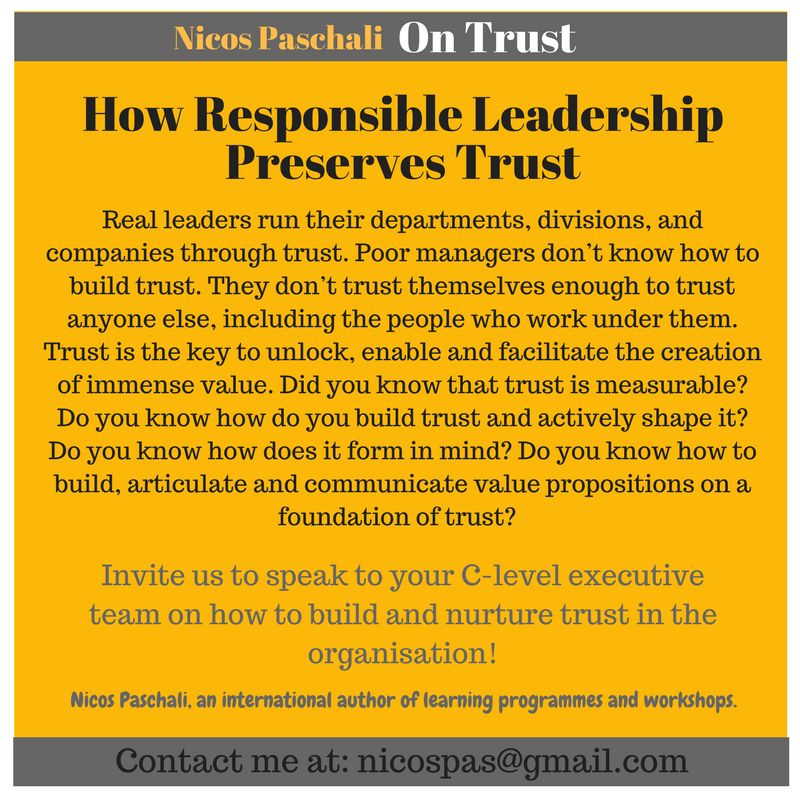
    • Nicos Paschali: An expert (as mentioned in the text) who offers learning programs and workshops on building and nurturing trust within organizations.

    Additional Notes:

    • The text emphasizes the practical and measurable aspects of trust.
    • Continuous learning and development are essential for leaders who want to cultivate trust within their organisations.
    • Consider exploring resources and methodologies for measuring trust, such as the Trust Index© developed by Great Place to Work®.
     
  • Unknown's avatar

    Nicos Paschali 2:07 pm on October 26, 2024 Permalink | Reply
    Tags: fascination, fiction, leadership, lifestyle, , nicos-profile, ,   

    Transformative Leadership Strategies with Nicos Paschali 

    Comprehensive Brief for Nicos Paschali: A Must-Have Solution

    Nicos Paschali is not merely a leader but a Must-Have Solution in transformative leadership, communication excellence, and talent development. His 40+ years of experience, unique personality traits and commitment to innovation make him an invaluable asset to individuals and organisations seeking to unlock their full potential.

    Key Strengths and Accomplishments:

    • Transformative Actionable Learning: Nicos’s revolutionary programme enhances communication skills, strengthens connections, and redefines learning and development strategies for sustained growth. This programme, a testament to his innovative thinking and passion for empowering others, transforms careers and lives, profoundly catalysing personal and professional development.
    • Global Reach and Impact: Nicos’s expertise transcends geographical boundaries, spanning Europe, the UAE, and Australasia. He has worked with a diverse clientele, ranging from government ministries to prominent tech companies, consistently delivering exceptional results.
    • Exceptional Communication and Emotional Intelligence: Nicos’s ability to connect with people on a deeper level is a defining characteristic. His communication is precise, passionate, and infused with empathy, commanding respect and trust in every interaction. He leverages storytelling, humour, and a vivid presentation style to engage his audience and drive impactful outcomes. His mastery of communication is further validated by his “Connoisseur” archetype, highlighting his warm, knowledgeable, and engaging personality.
    • Tech Visionary and Innovation Catalyst: Nicos possesses a deep understanding of cutting-edge technologies, including computer science, AI, and engineering. This expertise, combined with his innovative thinking, allows him to identify new opportunities, solve complex problems, and shape the future of businesses and industries. His strategic vision, grounded in a results-oriented approach and an understanding of interconnected systems, ensures sustainable solutions and long-term success.
    • Trusted Advisor and Mentor: Nicos excels at building trust and fostering genuine connections, making him a highly sought-after mentor. He empowers leaders and organisations to develop essential skills through tailored learning strategies, coaching, and workshops. He is not just a mentor but a catalyst for change, a beacon of excellence, and a guide on the pathway to transformative growth. His commitment to delivering amazing value and going the extra mile is evident in all his endeavours.

    Key Personality Traits:

    • Maximizer: Nicos is driven by a passion for excellence. He focuses on strengths as a way to stimulate personal and group excellence, constantly seeking to transform something strong into something superb. This is reflected in his belief that the greatest value one can add is to become more of oneself.
    • Achiever: Nicos possesses an unyielding work ethic and a constant need for achievement, fueled by his “Achiever” strength. This inherent drive is evident in his busy schedule, with 14 speaking engagements leading up to Christmas. He thrives in demanding situations that test his talents and endurance, constantly pushing himself to achieve new heights.
    • Learner: Nicos embodies the spirit of lifelong learning. He is passionate about continuous improvement and is energised by the process of acquiring knowledge and skills. His thirst for knowledge is evident in his wide-ranging certifications and expertise, encompassing areas like NLP, PhotoReading, and Accelerated Learning. He thrives in dynamic work environments where continuous learning is a necessity.
    • Ideation: Nicos’s mind is a wellspring of innovative ideas. He is fascinated by finding connections between seemingly disparate concepts and generating novel solutions. He thrives in environments that encourage brainstorming and out-of-the-box thinking, constantly seeking to challenge the status quo and improve existing processes.
    • Command: Nicos is a natural leader who can take charge and make difficult decisions. He is assertive, self-reliant, and comfortable expressing his views. His “Command” strength enables him to lead confidently and inspire others to act. Combined with his “Connoisseur” archetype, this trait allows him to tailor his communication style to different situations, ensuring maximum impact.

    Background and Education:

    • Extensive Experience: Nicos has over 35 years of experience in training, coaching, and presenting, having delivered over 65 seminar titles and 13,000 in-class training hours. This wealth of knowledge, accumulated over decades of hands-on learning and global engagement, forms the bedrock of his unique and insightful teaching style.
    • Solid Academic Foundation: Nicos holds a BSc in Communication & Electronic Engineering from Westminster University, UK, and studied Marketing & Management at the Caulfield Institute of Management, Australia. This strong academic foundation provides a solid base for his expertise in technology and business.
    • Continuously Expanding Skillset: Nicos possesses numerous certifications, including Microsoft Certified Engineer and Trainer, CISCO Certified Engineer, NLP Practitioner, PhotoReading Certified Instructor, and DISC Personality Assessor. This commitment to continuous learning ensures he remains at the forefront of his field, offering his clients the most up-to-date knowledge and techniques.
    • Multilingual Proficiency: Nicos is fluent in Greek (native) and English (proficient). This multilingual ability allows him to connect with a broader audience and deliver his message effectively across cultures.

    Why Nicos is a Must-Have Solution:

    • Nicos empowers businesses and individuals to succeed in a world of uncertainty and constant change. His “Must-Have Method” equips individuals with the tools and mindset needed to become indispensable in their fields, ensuring a reliable revenue stream that remains resilient against economic fluctuations.
    • He provides a tactical roadmap for improved performance, helping individuals earn compensation for their insights and results. Nicos’s approach goes beyond superficial self-improvement; it emphasises embracing your authentic self and leveraging your unique strengths for success.
    • Additionally, he offers a cost-effective solution that ensures a significant return on investment with minimal financial commitment.

    Understanding Nicos’s “Must-Have Method” is crucial for anyone looking to navigate the complexities of today’s volatile economic landscape. Here are several compelling reasons why people should care about this transformative approach:

    1. Resilience in Uncertainty: In a world where economic conditions can shift dramatically, having the tools to adapt and thrive is invaluable. Nicos’s method equips individuals with strategies to not only survive but excel, regardless of external circumstances. For example, during economic downturns, those armed with the right skills and mindset can pivot their careers, finding new opportunities where others may struggle.
    2. Value of Unique Strengths: Everyone has unique traits that can lead to success, but many people do not recognize or leverage these strengths effectively. Nicos’s approach encourages individuals to embrace their authentic selves, fostering a deeper self-awareness that can enhance personal and professional growth. For instance, someone with a knack for creative problem-solving might discover how to position themselves as a leader in innovation within their organization.
    3. Outstanding Return on Investment: The cost of self-improvement programs can often be prohibitive. Nicos offers a cost-effective solution that minimizes financial risk while maximizing potential returns. Think of it as a small investment that can lead to a substantial boost in income or career advancement—imagine a professional who, after implementing his tactics, secures a promotion or a higher-paying job.
    4. Compensation for Insights: In today’s knowledge-driven economy, those who can provide valuable insights and results are highly sought after. Nicos’s roadmap helps individuals articulate and demonstrate their value effectively, ensuring they receive the compensation they deserve. Picture an employee who successfully leverages their analytics skills to drive a significant increase in sales; that person will undoubtedly be recognized and rewarded.
    5. Long-Term Career Sustainability: The job market is continuously evolving, and the skills that are in demand today may not be relevant tomorrow. By embracing a mindset of continuous improvement and adaptability, individuals can future-proof their careers. Consider how many roles have vanished due to technological advancement; those who consistently upgrade their skills and knowledge are the ones who thrive.

    By engaging with Nicos’s insights and methodologies, individuals can unlock their full potential, ensure their relevance in an ever-evolving job market, and ultimately achieve lasting success in their personal and professional lives.

    Conclusion:

    Nicos Paschali is more than just a trainer or coach; he is a transformative force, a trusted advisor, and a beacon of excellence. His commitment to innovation, exceptional communication skills, and genuine passion for empowering others make him an essential resource in today’s ever-changing world. His programs and services provide a unique blend of practicality, insight, and inspiration, ensuring that every individual and organisation he works with experiences significant and lasting growth.

     
  • Unknown's avatar

    Nicos Paschali 4:43 am on October 25, 2024 Permalink | Reply
    Tags: , , leadership, ,   

    What critical decision-making skills are required for successful business leaders in Cyprus? 

    Some critical decision-making skills required for successful business leaders in Cyprus include:

    1. Strategic thinking and problem-solving: The ability to approach complex issues systematically, break them down, and craft comprehensive plans for the future. Leaders need to generate creative solutions while remaining practical and realistic.

    2. Data-driven decision-making: Using data analytics and decision modelling to transform data into meaningful insights that inform choices. The ability to interpret and use data to guide decisions is increasingly vital.

    3. Emotional intelligence: Understanding different communication styles, work habits, and values, especially when working with diverse teams and being attentive to stakeholders’ behaviours to build strong relationships.

    4. Adaptability and flexibility: The ability to adjust quickly to changing market conditions and remain relevant to change. This includes being open to new technologies and innovations.

    5. Stakeholder management: When making decisions, consider the needs and perspectives of all stakeholders – employees, customers, partners, etc. – and build consensus where appropriate.

    6. Risk assessment: Evaluating the pros and cons of alternatives, considering risks, uncertainties, and potential consequences of decisions and being willing to take calculated risks when needed.

    7. Ethical decision-making: Incorporating principles of conscious capitalism and considering the broader impact of decisions beyond profits.

    8. Communication skills: Conveying decisions, explaining rationales, and getting buy-in from team members and other stakeholders.

    9. Time management and prioritisation: Making timely decisions by effectively managing time, setting priorities, and balancing short-term and long-term considerations.

    10. Cultural awareness: Understanding the local business culture, including the importance of relationships, negotiation styles, and hierarchical structures in Cyprus.

    Developing these skills can help business leaders in Cyprus more effectively navigate the complexities of the local and global business environment. Making sound, strategic decisions is a hallmark of effective leadership in the Cypriot business context.

     
  • Unknown's avatar

    Nicos Paschali 4:21 am on October 12, 2024 Permalink | Reply
    Tags: achievement, , , leadership, , ,   

    “Discover Your Brilliance, Achieve the Extraordinary” 

    “Discover Your Brilliance, Achieve the Extraordinary”

    This isn’t just a catchy phrase; it’s a roadmap for personal and professional transformation. Let’s break down what this means for you:

     1. Discover Your Brilliance

    Every individual possesses unique strengths and talents. The journey begins with uncovering these hidden gems. We’ll identify your core strengths through targeted assessments and reflective exercises and align them with your goals. This process of self-discovery is often eye-opening, revealing capabilities you might not have recognised in yourself.

     2. Achieve the Extraordinary

    Once we’ve identified your strengths, we set ambitious goals. “Extraordinary” isn’t about competing with others—it’s about surpassing your own limits. We’ll craft a personalised strategy that pushes you beyond your comfort zone, turning your newfound self-awareness into tangible results.

     3. Unlock Your Potential

    Many of us have untapped reservoirs of potential. My role is to provide you with the tools and techniques to access these hidden capabilities. Through a combination of cutting-edge learning methodologies and personalised coaching, we’ll unlock doors you might not have known existed.

     4. Master New Heights

    Growth is an ongoing journey. As you achieve each goal, we’ll set new, more challenging objectives. This continuous cycle of learning, earning, and expanding ensures that you’re always moving forward, continually improving, and reaching new heights in your personal and professional life.

     5. Lead with Confidence

    Authentic leadership stems from self-assurance and a deep understanding of one’s capabilities. As you progress through this journey of self-discovery and achievement, you’ll naturally develop the confidence to lead others. We’ll hone your leadership skills, enabling you to inspire and guide teams with authenticity and vision.

     The Transformation

    This approach isn’t just about acquiring new skills but transforming you into a high-achieving, confident leader. It emphasises personal growth, tangible achievements, and leadership development. Whether you’re an aspiring manager, a seasoned executive, or an entrepreneur, this journey will equip you with the tools to excel in your field and inspire others.

    Are you ready to embark on this transformative journey? To discover your brilliance, achieve the extraordinary, and lead with unshakeable confidence? Let’s connect and explore how we can unlock your true potential together.

    Nicos Paschali

    Executive Coach | Leadership Facilitator | Performance Catalyst

    Please send me a DM to discuss solutions to your challenges.


  • Unknown's avatar

    Nicos Paschali 1:44 pm on October 10, 2024 Permalink | Reply
    Tags: , , leadership, , , ,   

    The Importance of Disagreement in Building Strong RelationshipsImage Post 

    The Importance of Disagreement in Building Strong Relationships

    Disagreement is often misunderstood as conflict, yet it serves as a crucial foundation for deep relationships to flourish. Dr. Cloud emphasizes that embracing disagreement can lead to personal and team growth, encourage authenticity, and prevent resentment. This document explores the key benefits of fostering an environment where disagreement is welcomed and respected.

    Promotes Personal and Team Growth

    When individuals feel free to express their disagreements, it cultivates an atmosphere ripe for creativity and innovation. Openly challenging and refining ideas leads to more robust decision-making and solutions. This dynamic not only enhances individual growth but also strengthens team performance, as diverse perspectives contribute to a richer pool of ideas.

    Encourages Authenticity

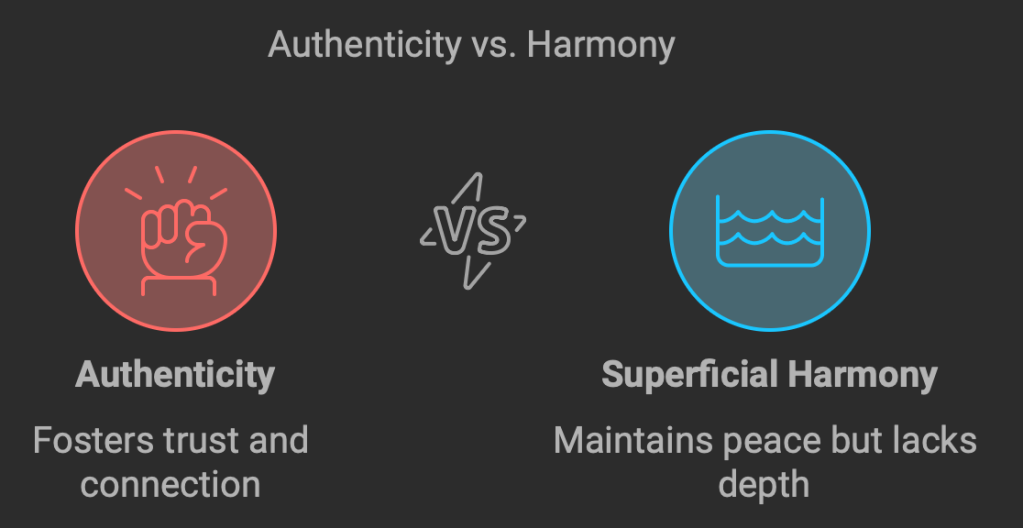
    The ability to disagree fosters authenticity in relationships. When people can express differing opinions without fear of judgment, they are more likely to show up as their true selves. This authenticity builds trust and strengthens connections, allowing relationships to thrive on genuine understanding rather than superficial harmony.

    Prevents Resentment and Conflict

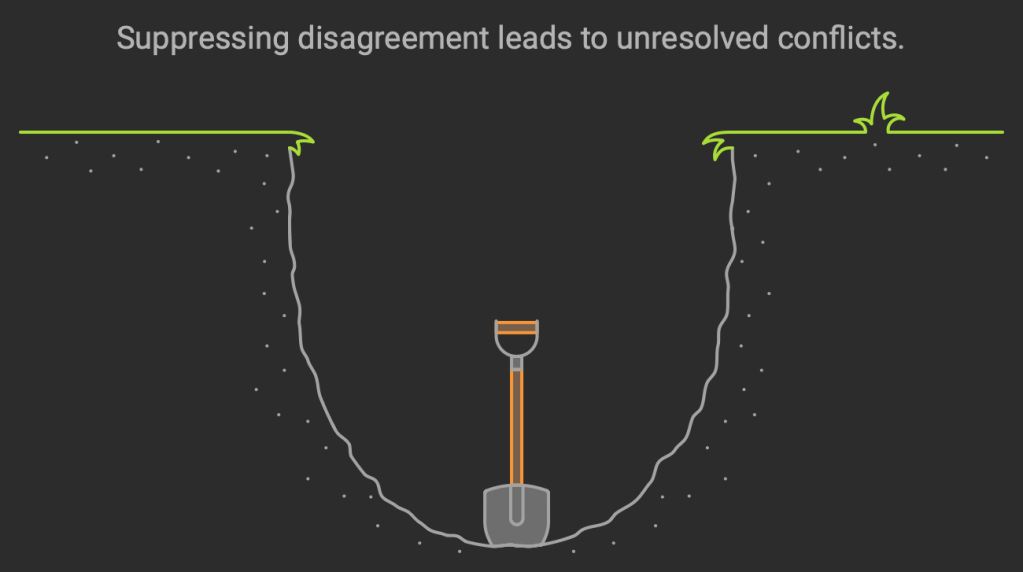
    Suppressing disagreement can lead to unresolved issues that fester over time, ultimately resulting in more significant conflicts. By allowing disagreements to be expressed openly and addressed respectfully, tension can be diffused before it escalates. This proactive approach not only prevents long-term relational damage but also promotes a healthier, more communicative environment.

    In conclusion, embracing disagreement is essential for nurturing deep, meaningful relationships. By recognizing its value in promoting growth, encouraging authenticity, and preventing conflict, individuals and teams can create a more dynamic and resilient relational landscape.

     
c
Compose new post
j
Next post/Next comment
k
Previous post/Previous comment
r
Reply
e
Edit
o
Show/Hide comments
t
Go to top
l
Go to login
h
Show/Hide help
shift + esc
Cancel